
Starch Portal
A complete toolkit for the study of starch and the enzymes that act on it
Starch is the main source of carbohydrates in the human diet. It occurs in plants as a storage polysaccharide and is found in high abundance in seeds and tubers. Starch is clearly of huge importance to the food industry but is also important to the paper, textiles, bioplastics and oil industries. Starch consists of two component subgroups:
1) amylose – made up of long linear chains of α-1,4-D-glucose residues (DP ~ 300-3000) and 2) amylopectin – that contains linear chains of 1,4-α-linked D-glucosyl residues joined through 1,6-α-branch points which represent between 3 and 4.2% of total linkages. The equivalent storage polysaccharide in animal tissue, namely glycogen, contains a higher degree of branching, with 1,6-branch points representing approximately 10% of total linkages.
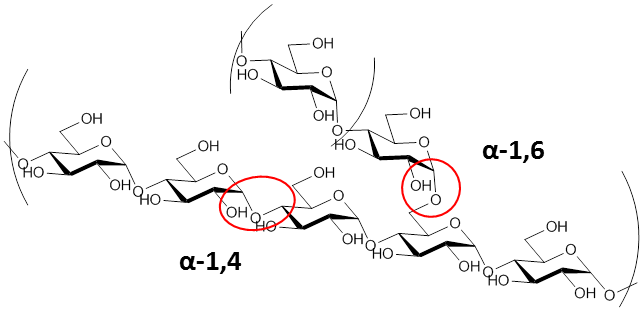
Figure: Amylopectin is composed of linear α-1,4-D-glucopyranosyl chains with α-1,6 branch points every 24-30 residues.
Resistant Starch is the term given to any starch that is resistant to hydrolysis by the enzymes present in the human small intestine. Four different types of resistant starch have been defined by Englyst et al. (Englyst, H. N. Kingman, S. M. & Cummings, J. H. (1992). European J. Clin. Nutr., 46 (Suppl. 2), S33-S50).
RS1: Physically inaccessible starch, such as that found in seeds or legumes and unprocessed whole grains.
RS2: Resistant starch that occurs in its natural granular form, such as uncooked potato, green banana flour and high amylose corn.
RS3: Resistant starch that is formed when starch-containing foods are cooked and cooled such as in legumes, bread, cornflakes and cooked-and-chilled potatoes, pasta salad or sushi rice. This treatment leads to retrogradation – the recrystallisation of amylose and amylopectin on cooling – which makes starch resistant to enzymatic hydrolysis.
RS4: Starches that have been synthetically modified to resist digestion. This type of resistant starch can exhibit a broad range of structural diversity.
The analysis of how starch in food is degraded by the enzymes in the human digestive system is very important for the calculation of dietary fiber (undigested component) and available carbohydrates (digested component) in food. Neogen® is the industry leader in this area and extensive information on the topic can be found in our dietary fiber portal.
Assay Kits
Starch and starch components
As part of our Megazyme range, we have developed a number of novel assay kits for the study of starch. It is possible using enzymatic methods to determine the total starch (K-TSHK, K-TSTA, AOAC 996.11) and resistant starch (K-RSTAR, AOAC 2002.02) content in any sample using these AOAC approved methods. Recently however, Neogen®'s Megazyme team has undertaken a major research initiative to improve the resistant starch method. This has resulted in the development of the Rapid Resistant Starch procedure (K-RAPRS) which, in line with our latest dietary fiber methodology (K-RINTDF, AOAC 2017.16), employs a 4 h enzyme incubation in place of the existing 16 h procedure. This generates more physiologically relevant results given that the average residence time of food in the small intestine is ~ 4 h. A new assay procedure (K-DSTRS) based on the same methodology allows for the determination of rapidly digested starch (RDS), slowly digested starch (SDS), total digestible starch (TDS) and resistant starch. Amylose and amylopectin content in a sample can also be determined using Megazyme's Amylose/Amylopectin (K-AMYL) assay kit which is based on a Concanavalin A mediated precipitation step. The level of so-called ‘starch damage’ is another starch property that can be analysed enzymatically using the Starch Damage (K-SDAM) assay kit. In this kit, highly purified fungal α-amylase can act to break down damaged starch granules but displays almost no hydrolytic activity on undamaged granules. Dietary fiber (K-TDFR for AOAC 985.29, AOAC 991.43, AOAC 2001.03; K-INTDF for AOAC 2009.01, AOAC 2011.25 and K-RINTDF for AOAC 2017.16) can be measured using enzymatic-gravimetric procedures. The complementary analyte, Available Carbohydrates, can be determined in line with “Prosky-type” incubation conditions using K-ACHDF or the modern “McCleary” incubation conditions (physiologically relevant 4 h incubation) using K-AVCHO. Free glucose content in a sample can be determined using either glucose oxidase or hexokinase procedures (K-GLUC and K-GLUHK).
| Product Code | Product Name |
| K-TSTA | Total Starch (GOPOD method) |
| K-TSHK | Total Starch (hexokinase method) |
| K-TSCK | Total Starch Control Flours |
| K-DSTRS | Digestible Resistant Starch |
| K-RAPRS | Resistant Starch (rapid) |
| K-RSTAR | Resistant Starch |
| K-RSTCL | Resistant Starch Control Flours |
| K-AMYL | Amylose/Amylopectin |
| K-SDAM | Starch Damage |
| K-TDFR | Total Dietary Fiber |
| K-INTDF | Integrated Total Dietary Fiber |
| K-RINTDF | Rapid Integrated Total Dietary Fiber |
| K-TDFC | Total Dietary Fiber Controls |
| K-ACHDF | Available Carbohydrates/Dietary Fiber |
| K-GLUC | Glucose (GOPOD method) |
| K-GLUHK | Glucose (hexokinase method) |
Starch degrading enzymes
Defined colourimetric oligosaccharides have been formulated into assay kits to measure the major enzymes involved in starch degradation including α-amylase, β-amylase, amyloglucosidase and pullulanase/limit-dextrinase. In some cases, the reagent components from these kits are also available individually.
| Product Code | Product Name |
| α-Amylase | |
| K-CERA | Ceralpha Assay |
| R-AMHR4 | Amylase HR Reagent |
| R-CAAR4 | Ceralpha Reagent |
| K-AMYLSD | Amylase SD |
| K-MALTA | Malt Amylase (α- plus β-amylase) |
| β-Amylase | |
| K-BETA3 | Betamyl-3 Assay |
| R-BAMR3 | Betamyl-3 Reagent |
| Amyloglucosidase | |
| R-AMGR3 | Amyloglucosidase Reagent |
| Pullulanase/Limit-Dextrinase | |
| K-PullG6 | Pullulanse/Limit-Dextrinase |
Carbohydrates
Oligosaccharides
Mixed linkage amylooligosaccharides are available from our Megazyme range for use as chromatographic standards and for use in enzyme characterisation and binding studies.
| Product Code | Product Name |
| O-PAN | Panose |
Polysaccharides
β-Limit dextrin is available as a substrate for the measurement of α-amylase activity according to the Farrand, AACC (SKB Units) or ASBC (Dextrinising Units, DU) iodine based methods.
Enzymes
α-Amylase (EC 3.2.1.1) is an endo-acting enzyme that hydrolyses α-1,4 glucose linkages in starch. It is available from bacterial, fungal and porcine sources in general analytical and ultra-pure form from our Megazyme range.
β-Amylase (EC 3.2.1.2) is an exo-acting enzyme that cleaves maltose units from the non-reducing end of α-1,4 oligosaccharides and polysaccharide starch fragments.
α-Glucosidase (EC 3.2.1.20) is an exo-acting enzyme that cleaves glucose units from the non-reducing end of α-1,4 oligosaccharide and polysaccharide starch fragments.
Amyloglucosidase (EC 3.2.1.3) is another exo-acting enzyme that operates on the non-reducing end of starch oligomers and polymers, however it hydrolyses α-1,6 linkages as well as the α-1,4 linkages. This is a key enzyme employed in the assay of dietary fiber in the food industry. Contaminants are often present in commercial preparations of this enzyme that can strongly affect the assay results. Neogen®'s Megazyme formulation (E-AMGDF) has the highest purity commercially available.
Limit-dextrinase is an endo-acting enzyme that occurs in low abundance in nature but is of crucial importance to certain industries, notably the brewing industry. Limit-dextrinase hydrolyses the α-1,6 linkages in starch but displays strict substrate binding requirements. For example, limit dextrinase exhibits no activity on 63-α-D-glucosyl-maltotriose but readily hydrolyses 63-α-D-maltotriosyl-maltotriose. Pullulanase is the microbial source equivalent enzyme of limit-dextrinase.
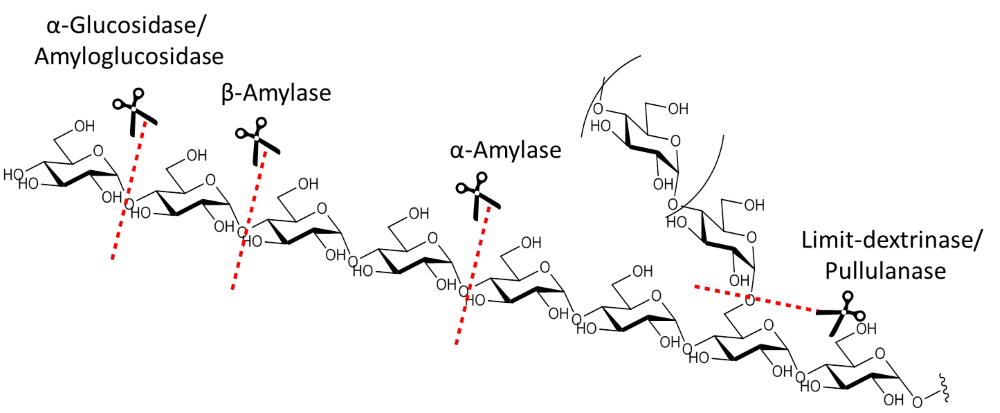
Figure: Schematic representation of the hydrolytic action of starch degrading enzymes.
| Product Code | Product Name |
| E-MAST | Malt amylase standard (a mixture of α- and β-amylases) |
| α-Amylase | |
| E-BLAAM | α-Amylase (Bacillus licheniformis) (high purity) |
| E-ANAAM | α-Amylase (Aspergillus orzyae) (high purity) |
| E-PANAA | α-Amylase (Porcine pancreatic) (partially purified) |
| β-Amylase | |
| E-BARBP | β-Amylase (Barley) (ultra high purity) |
| α-Glucosidase | |
| E-TSAGS | Recα-Glucosidase (Bacillus stearothermophilus) (ultra high purity) |
| E-MALTS | α-Glucosidase (yeast maltase) (ultra high purity) |
| Amyloglucosidase | |
| E-AMGDF | Amyloglucosidase (Aspergillus niger) (analytical grade) |
| E-AMGDFNG | Amyloglucosidase (Aspergillus niger) Glycerol Free |
| E-AMGDFPD | Amyloglucosidase (powder) (Aspergillus niger) (analytical grade) |
| E-AMGFR | Amyloglucosidase (Aspergillus niger) (analytical grade) |
| E-AMGPU | Amyloglucosidase (Rhizopus sp.) (ultra high purity) |
| Pullulanase | |
| E-PULKP | Pullulanase M1 (Klebsiella planticola) (ultra high purity) |
| E-PULBL | Pullulanase M2 (Bacillus licheniformis) (ultra high purity) |
| Rec (recombinant enzyme) | |
Enzyme Substrates
Insoluble and soluble chromogenic enzyme substrates for the detection and measurement of α-amylase have been prepared from AZCL-amylose and dyed starch respectively. The analogous substrates for limit-dextrinase/pullulanase have been derived from AZCL-pullulan and dyed pullulan.
Soluble chromogenic substrates upon incubation with the requisite endo-acting enzyme produce a colourimetric response that can be related to enzyme activity through the standard curve provided.
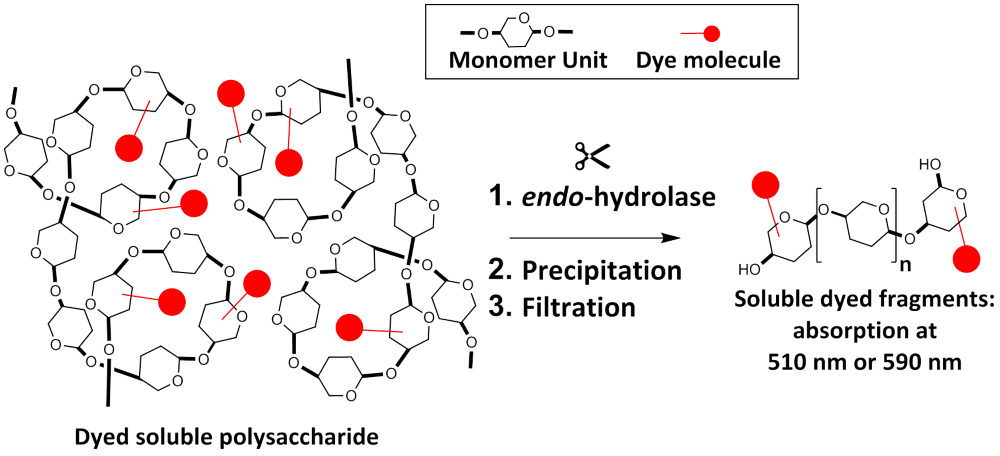
Insoluble chromogenic substrates are recommended for qualitative screening experiments on agar/gels but these substrates are also available in tablet form where they can be employed in quantitative assays (again by relating measured absorbance back to a standard curve provided) with improved convenience and therefore higher throughput for the analyst.


