
Arabinoxylan Portal
A complete solution for the study of arabinoxylan and the enzymes that act on it
Arabinoxylan is a significant component of cereal hemicelluloses. It has become a functional food ingredient of interest with beneficial health benefits linked to its prebiotic effects. Understanding the enzymatic mechanisms for the complete degradation of this polysaccharide is also essential for the biofuels industry by allowing the efficient conversion and utilisation of plant biomass. An article recently published by McCleary et al. discusses the action of the various enzymes involved in the hydrolysis of wheat arabinoxylan.1
Structurally, arabinoxylan consists of a β-1,4 linked xylan backbone with the xylose monomers bearing a mixture of either 3- monosubstituted or 2,3-disubstituted α-L-arabinose. Some arabinofuranosyle residues are further substituted with ferulic acid, which under certain circumstances can crosslink to other ferulic acid residues, forming di-ferulate bridges.

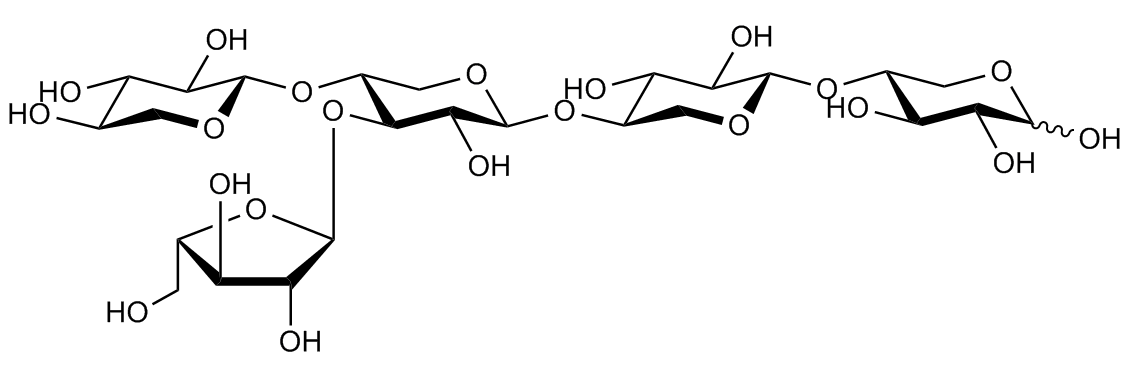
Figure: Arabinoxylan contains D-xylosyl monomeric units linked β-1,4 and extensively modified with α-L-arabinofuranosyl residues on positions 2 and 3.
Assay Kits
Neogen®'s Megazyme range currently provides kits for the assay of xylanase activity and is developing an enzymatic assay kit for the determination of wheat flour arabinoxylan. This will be the first commercially available kit of its kind.
Carbohydrates
Oligosaccharides
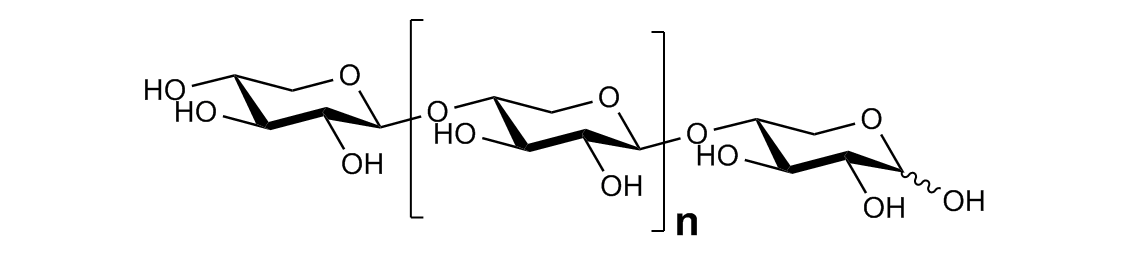
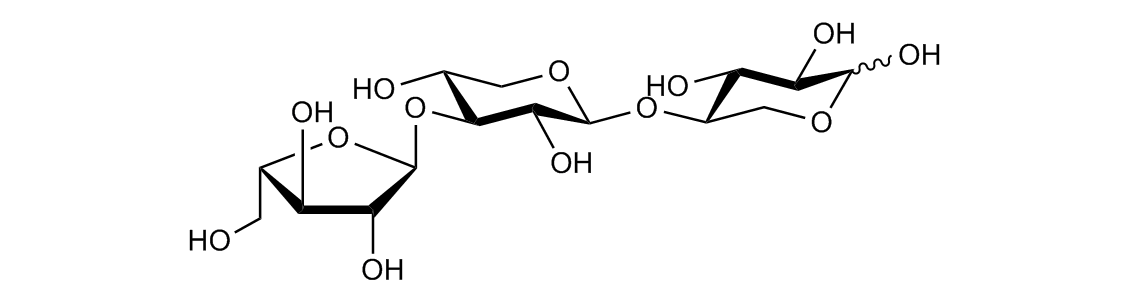
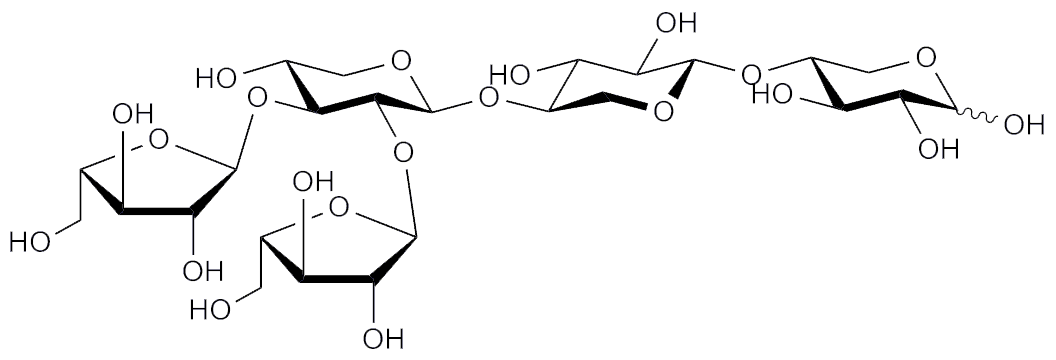
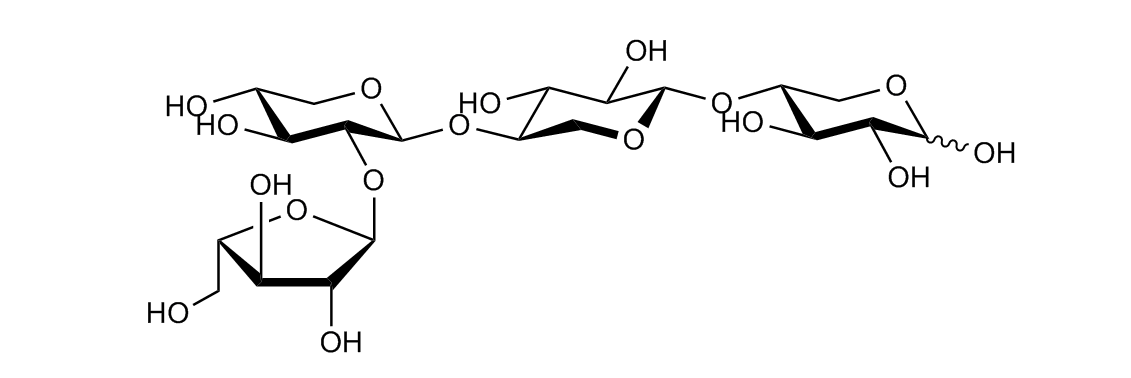
Specific xylo-oligosaccharides (XOS) and arabinoxylo-oligosaccharides (AXOS) have been prepared with high purity for use, as chromatographic standards, and in enzyme characterisation and binding studies.
Polysaccharides
Arabinoxylan polysaccharides obtained from rye and wheat are available from our Megazyme range. High, medium and low viscosity grades have been prepared with these viscosities indicating the molecular weight range of each product. Acid and enzyme debranched arabinoxylans have also been produced providing alternative substrates with varying degrees of arabinose substitution. Xylan sourced from beechwood is available as a substrate for reducing sugar assays of endo-1,4-β-xylanase. Beechwood xylan contains approximately 10% 4-O-methylglucuronate substitution, which is exactly the same as that in birchwood xylan.
| Product Code | Product Name |
| P-RAXY | Arabinoxylan (rye flour; high viscosity) |
| P-WAXYL | Arabinoxylan (wheat flour; low viscosity) |
| P-WAXYM | Arabinoxylan (wheat flour; medium viscosity) |
| P-WAXYH | Arabinoxylan (wheat flour; high viscosity) |
| P-WAXYRS | Arabinoxylan (wheat flour; for Sugar Reducing Assays; specifically for use in Nelson-Somogyi reducing sugar assays for β-xylanase) |
| P-WAXYI | Arabinoxylan (wheat flour; insoluble) |
| P-XYLNBE | Xylan (highly purified from beechwood). Suitable as a replacement for birchwood xylan as a substrate for β-xylanase in DNSA reducing sugar assays |
Enzymes
endo-1,4-β-Xylanases (EC 3.2.1.8) have the ability to hydrolyse the interlinking β-1,4 glycosidic bonds present in the xylan backbone to varying degrees based on 1) the identity of the endo-xylanase in question and 2) the neighbouring arabinose substitution present.
exo-1,4-β-Xylosidases (EC 3.2.1.37) sequentially hydrolyse xylose residues, one unit at a time, from the non-reducing end of xylo-oligosaccharides.
α-L-Arabinofuranosidases (EC 3.2.1.55) can cleave the arabinofuranose residues from the xylan backbone with strict specificity in some cases for 3-mono-substituted or 2,3-di-substituted arabinofuranose bearing xylose residues.
Feruloyl esterases (EC 3.1.1.73) cleave the ferrulate crosslinks between arabinoxylan and other polymeric structures within hemicellulose.
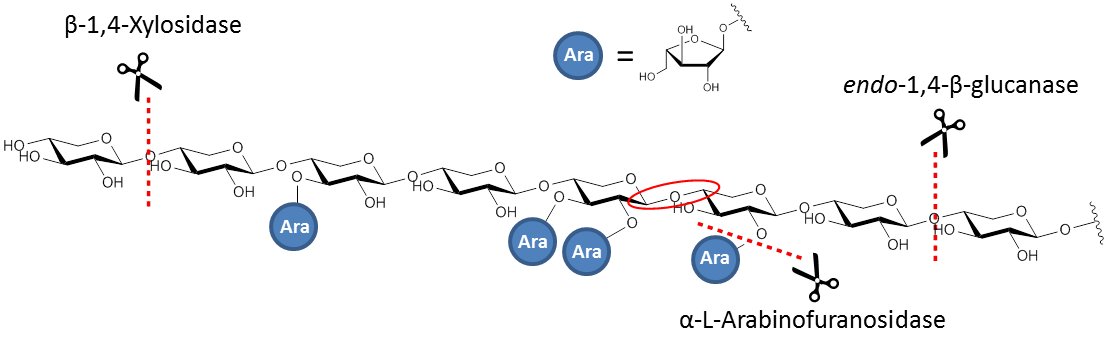
Figure: Schematic representation of the hydrolytic action of arabinoxylan degrading enzymes.
| Product Code | Product Name |
| endo-1,4-β-Xylanases | |
| E-XYLNP | Recendo-1,4-β-Xylanase (Neocallimastix patriciarum) |
| exo-1,4-β-Xylosidases | |
| E-BXSR | Recβ-D-Xylosidase (Selenomonas ruminantium) |
| α-L-Arabinofuranosidases | |
| E-AFASE | α-L-Arabinofuranosidase (Aspergillus niger) |
| Feruloyl Esterases | |
| E-FAERU | RecFeruloyl Esterase (rumen microorganism) |
| Rec (recombinant enzyme) | |
Enzyme Substrates
Colourimetric oligosaccharides with a chemically-defined structure are available for the measurement of the activity of α-L-arabinofuranosidases. These are suitable for use in both manual and high throughput automated analysis applications. The activity of the enzyme assayed can be determined directly by measuring the absorption increase at 400 nm which corresponds to the release of the nitrophenolate ion in solution.
| Product Code | Product Name |
| α-L-Arabinofuranosidase substrates | |
| O-PNPAF | 4-Nitrophenyl-α-L-arabinofuranoside |
 | |
Soluble chromogenic enzyme substrates derived from arabinoxylan and xylan (birchwood) have been prepared for the detection and specific measurement of endo-xylanase activity. These substrates produce a colourimetric response upon incubation with a suitable xylanase that can be related to enzyme activity through the standard curve provided (soluble substrates only) or used for screening on agar plates.
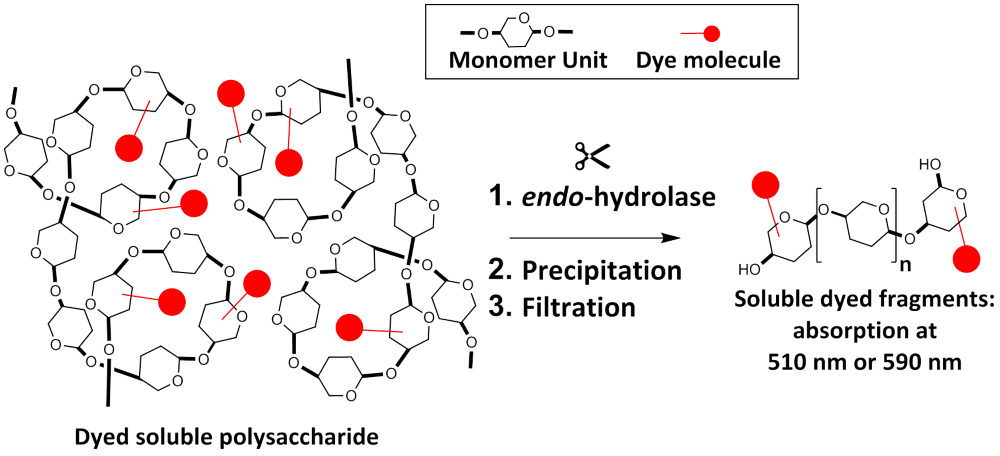
Figure: Schematic representation of the use of dyed polysaccharides (soluble) for the assay of endo-hydrolase activity.
| Product Code | Product Name |
| Tablets | |
| T-XAX | Xylazyme AX (very versatile, highly sensitive and widely used substrates for the assay of endo-xylanase) |
| T-XYZ | Xylazyme (very versatile, highly sensitive and widely used substrates for the assay of endo-xylanase) |
| Soluble Substrates | |
| S-AWAXP | Azo-Wheat Arabinoxylan (powder) |
| S-AXBP | Azo-Xylan (birchwood) (powder) |
1 McCleary, B. V., McKie, V. A., Draga, A., Rooney, E., Mangan, D. & Larkin, J. (2015). Hydrolysis of wheat flour arabinoxylan, acid-debranched wheat flour arabinoxylan and arabino-xylo-oligosaccharides by β-xylanase, α-L-arabinofuranosidase and β-xylosidase. Carbohydrate Research, 407, 75-96. Link to Article


