
β-Glucan Portal
A complete toolkit for the study of mixed linkage (1,3:1,4)-β-glucan and the enzymes that act on it
Mixed linkage (1,3:1,4)-β-glucan is found in the endosperm cell walls of cereal grains such as oat and barley, and to a lesser extent wheat and rye. The health benefits associated with β-glucan are well established and this makes it a vital component of interest to the food industry. High levels of β-glucan in animal feeds lead to reduced feed intake and decreased feed conversion.
β-Glucan is also an important analyte in the brewing industry where elevated levels can lead to increased wort viscosity and cause processing problems. It is therefore essential to understand the enzymatic mechanisms for the complete degradation of this polysaccharide, its structure and its functional properties.
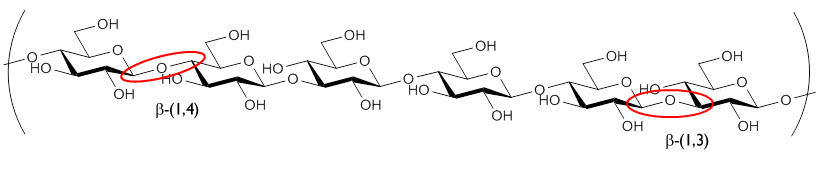
Figure: β-Glucan is composed of D-glucosyl monomeric units linked either β-1,3 or β-1,4.
Assay Kits
As part of our Megazyme range, we have developed a novel assay kit for the measurement of mixed linkage β-glucan in all samples (K-BGLU: AOAC 995.16, CODEX Type II method). An assay kit based on the dye-labelled native polysaccharide (K-MBGL) is also available for the measurement of endo-acting β-glucan degrading enzymes including endo-1,3(4)-β-glucanase/lichenase and endo-1,4-β-glucanase/endo-cellulase. endo-1,4-β-Glucanase can be specifically measured using the novel CellG5 assay kit (K-CellG5). Free glucose content in a sample can be determined using either glucose oxidase or hexokinase procedures (K-GLUC and K-GLUHK).
Carbohydrates
Oligosaccharides
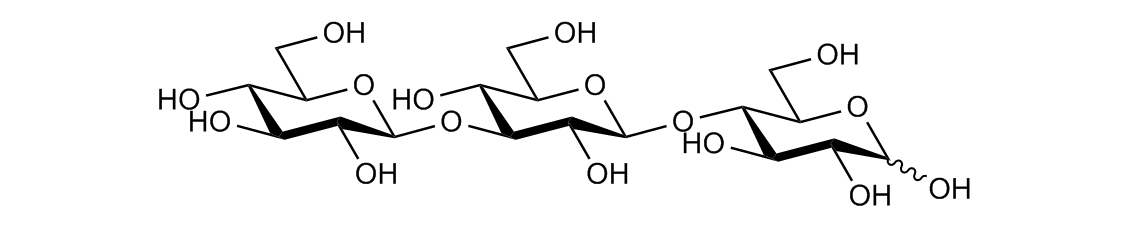
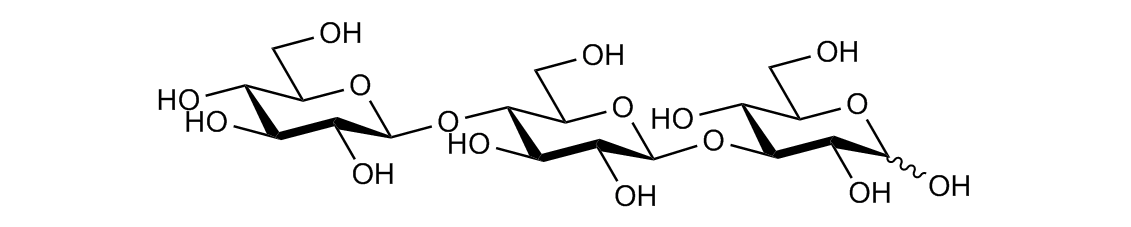
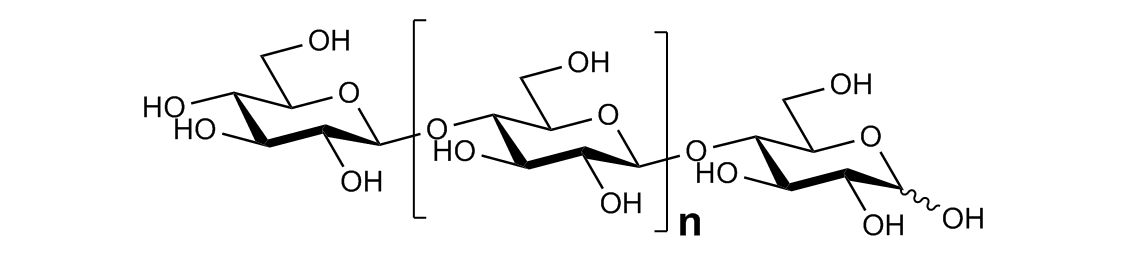
A number of mixed linkage (β-1,3:1,4) DP3 and DP4 gluco-oligosaccharides have been prepared with high purity for use as chromatographic standards and for use in enzyme characterisation and binding studies. The corresponding cello-oligosaccharides may also prove useful in this regard.
Polysaccharides
Neogen® produces and supplies high purity (1,3:1,4)-β-D-glucan from oat and barley as part of our Megazyme range. β-Glucans which have high, medium and low viscosity grades have been prepared with these viscosities indicating the molecular weight range in each product. Lichenan isolated from Icelandic moss is an alternative source of β-glucan with a higher proportion of β-1,3 linkages. Carboxymethyl cellulose 4M is a medium viscosity cellulose with a degree of substitution with carboxymethyl groups of 0.4. This lower degree of substitution than carboxymethyl cellulose offered by other suppliers (typically DS 0.7) is more readily hydrolysed by the full spectrum of endo-cellulases, and thus universally useful for the assay of this enzyme.
| Product Code | Product Name |
| P-BGBL | β-Glucan (barley; low viscosity, high purity) |
| P-BGBM | β-Glucan (barley; medium viscosity, high purity) |
| P-BGBH | β-Glucan (barley; high viscosity, high purity) |
| P-BGOM | β-Glucan (oat; medium viscosity, high purity) |
| P-BGCFA | β-Glucan CFA standard |
| P-MWBGS | β-Glucan MW standards |
| P-LICHN | Lichenan (Icelandic moss) |
Enzymes
Lichenase (EC 3.2.1.73) selectively hydrolyses β-1,4 glycosidic bonds adjacent to a β-1,3 linked glucose residue on their reducing side.
β-Glucosidases (EC 3.2.1.21) act sequentially, hydrolysing one glucose residue at a time, from the non-reducing end of oligosaccharide/polysaccharide fragments. They have varying specificity for β-1,4 and β-1,3 glycosidic bonds.
Cellobiohydrolases (EC 3.2.1.91) act in a similar exo- fashion but cleave disaccharide (cellobiosyl) units.
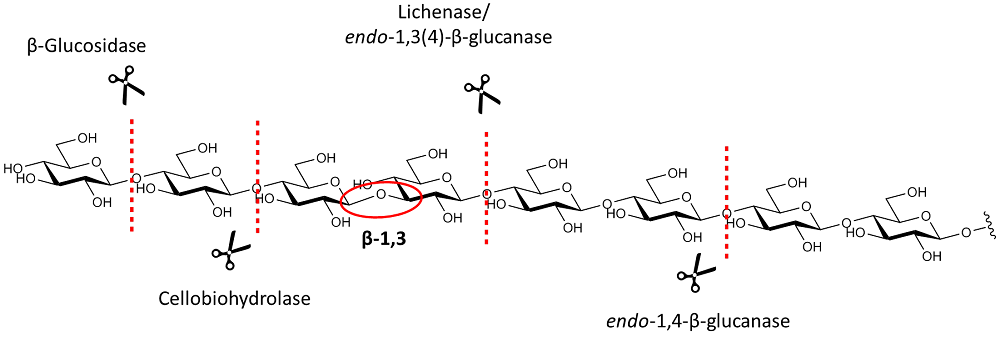
Figure: Schematic representation of the hydrolytic action of β-glucan degrading enzymes.
| Product Code | Product Name |
| β-Glucanases | |
| E-LICHN | Lichenase (Bacillus subtilis) |
| exo-1,4-β-Glucosidases | |
| E-BGLUC | β-Glucosidase (A. niger) (pH optima 4.0) |
| E-BGOSAG | β-Glucosidase (Agrobacterium sp.) (pH optima 6.5) |
| exo-1,3-β-Glucanases | |
| E-EXBGOS | exo-1,3-β-D-Glucanase + β-Glucosidase |
| E-EXBGTV | Recexo-1,3-β-Glucanase (Trichoderma virens) (pH optima 4.5) |
| Cellobiohydrolases | |
| E-CBHII | Cellobiohydrolase I (T. longibrachiatum) (pH optima 4.5) |
| Rec (recombinant enzyme) | |
Enzyme Substrates
Insoluble and soluble chromogenic enzyme substrates for the detection and measurement of endo-(1,3:1,4)-β-glucanase activity have been prepared from (1,3:1,4)-β-glucan. These substrates produce a colourimetric response upon incubation with a suitable endo-(1,3:1,4)-β-glucanase that can be related to enzyme activity through the standard curve provided (S-ABG100 only) or be used for screening on agar plates. The insoluble substrate is also available in tablet form to increase accuracy and convenience for the user when assaying specific enzyme activity. It should be noted that as many endo-1,4-β-glucanases also act on (1,3:1,4)-β-glucan, these substrates will also be hydrolysed by some endo-1,4-β-glucanases. Analogous versions of these dyed polysaccharide substrates that are specific for endo-1,4-β-glucanase are also available.
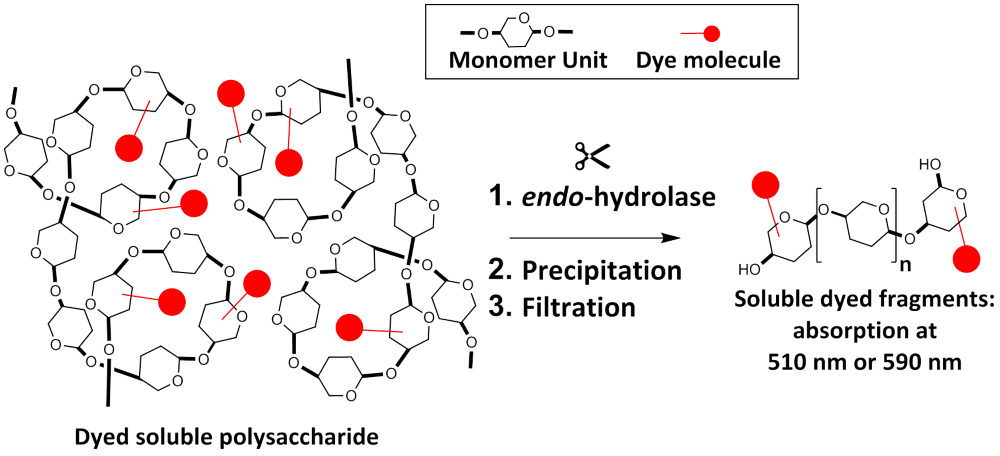
Figure: Schematic representation of the use of dyed polysaccharides (soluble) for the assay of endo-β-glucanase activity.
| Product Code | Product Name |
| endo-(1,3:1,4)-β-Glucanase substrates (and endo-(1,4)-β-Glucanase substrates) | |
| Tablets | |
| T-BGZ | β-Glucazyme (containing AZCL-Barley β-glucan) |
| Soluble Substrates | |
| S-ABG100 | Azo-Barley Glucan |
| Specific endo-1-4-β-Glucanase substrates | |
| Tablets | |
| T-CCZ | Cellazyme C (containing AZCL-HP-cellulose) |
| T-CTZ | Cellazyme T (containing AZCL-tamarind xyloglucan) |
| Soluble Substrates | |
| S-ACMC | Azo-CM-Cellulose (powder) |
| Insoluble Substrates | |
| I-AZCEL | AZCL-HE-Cellulose |


