
33-α-L- plus 23-α-L-Arabinofuranosyl-xylotetraose (XA3XX/XA2XX) mixture
30 mg
This product has been discontinued
These products have been discontinued (read more).
High purity 33-α-L- plus 23-α-L-arabinofuranosyl-xylotetraose (XA3XX/XA2XX) mixture for use in research, biochemical enzyme assays and in vitro diagnostic analysis. It can be used as a substrate to help characterise the activities of arabinoxylan degrading enzymes including endo-xylanase, β-xylosidase and α-L-arabinofuranosidase. This compound was prepared by the controlled enzymatic hydrolysis of wheat arabinoxylan.
View other oligosaccharide products for research.
Data booklets for each pack size are located in the Documents tab.
Related Products
Similar Products
Colourimetric Substrates
Associated Enzymes
Publications

Structural and functional analysis of a multimodular hyperthermostable xylanase-glucuronoyl esterase from Caldicellulosiruptor kristjansonii.
Krska, D., Mazurkewich, S., Brown, H. A., Theibich, Y., Poulsen, J. C. N., Morris, A. L., Koropatkin, N. M., Leggio, L. L. & Larsbrink, J. (2021). Biochemistry, 60(27), 2206-2220.
Structural and functional analysis of a multimodular hyperthermostable xylanase-glucuronoyl esterase from Caldicellulosiruptor kristjansonii.
Krska, D., Mazurkewich, S., Brown, H. A., Theibich, Y., Poulsen, J. C. N., Morris, A. L., Koropatkin, N. M., Leggio, L. L. & Larsbrink, J. (2021). Biochemistry, 60(27), 2206-2220.
The hyperthermophilic bacterium Caldicellulosiruptor kristjansonii encodes an unusual enzyme, CkXyn10C-GE15A, which incorporates two catalytic domains, a xylanase and a glucuronoyl esterase, and five carbohydrate-binding modules (CBMs) from families 9 and 22. The xylanase and glucuronoyl esterase catalytic domains were recently biochemically characterized, as was the ability of the individual CBMs to bind insoluble polysaccharides. Here, we further probed the abilities of the different CBMs from CkXyn10C-GE15A to bind to soluble poly- and oligosaccharides using affinity gel electrophoresis, isothermal titration calorimetry, and differential scanning fluorimetry. The results revealed additional binding properties of the proteins compared to the former studies on insoluble polysaccharides. Collectively, the results show that all five CBMs have their own distinct binding preferences and appear to complement each other and the catalytic domains in targeting complex cell wall polysaccharides. Additionally, through renewed efforts, we have achieved partial structural characterization of this complex multidomain protein. We have determined the structures of the third CBM9 domain (CBM9.3) and the glucuronoyl esterase (GE15A) by X-ray crystallography. CBM9.3 is the second CBM9 structure determined to date and was shown to bind oligosaccharide ligands at the same site but in a different binding mode compared to that of the previously determined CBM9 structure from Thermotoga maritima. GE15A represents a unique intermediate between reported fungal and bacterial glucuronoyl esterase structures as it lacks two inserted loop regions typical of bacterial enzymes and a third loop has an atypical structure. We also report small-angle X-ray scattering measurements of the N-terminal CBM22.1–CBM22.2–Xyn10C construct, indicating a compact arrangement at room temperature.
Mechelke, M., Koeck, D. E., Broeker, J., Roessler, B., Krabichler, F., Schwarz, W. H., Zverlov, V. V. & Liebl, W. (2017). Journal of Biotechnology, 257, 122-130.
Mechelke, M., Koeck, D. E., Broeker, J., Roessler, B., Krabichler, F., Schwarz, W. H., Zverlov, V. V. & Liebl, W. (2017). Journal of Biotechnology, 257, 122-130.
Herbinix hemicellulosilytica is a newly isolated, gram-positive, anaerobic bacterium with extensive hemicellulose-degrading capabilities obtained from a thermophilic biogas reactor. In order to exploit its potential as a source for new industrial arabinoxylan-degrading enzymes, six new thermophilic xylanases, four from glycoside hydrolase family 10 (GH10) and two from GH11, three arabinofuranosidases (1x GH43, 2x GH51) and one β-xylosidase (GH43) were selected. The recombinantly produced enzymes were purified and characterized. All enzymes were active on different xylan-based polysaccharides and most of them showed temperature-vs-activity profiles with maxima around 55–65°C. HPAEC-PAD analysis of the hydrolysates of wheat arabinoxylan and of various purified xylooligosaccharides (XOS) and arabinoxylooligosaccharides (AXOS) was used to investigate their substrate and product specificities: among the GH10 xylanases, XynB showed a different product pattern when hydrolysing AXOS compared to XynA, XynC, and XynD. None of the GH11 xylanases was able to degrade any of the tested AXOS. All three arabinofuranosidases, ArfA, ArfB and ArfC, were classified as type AXH-m,d enzymes. None of the arabinofuranosidases was able to degrade the double-arabinosylated xylooligosaccharides XA2+3XX. β-Xylosidase XylA (GH43) was able to degrade unsubstituted XOS, but showed limited activity to degrade AXOS.
Mechelke, M., Herlet, J., Benz, J. P., Schwarz, W. H., Zverlov, V. V., Liebl, W. & Kornberger, P. (2017). Analytical and Bioanalytical Chemistry, 1-13.
Mechelke, M., Herlet, J., Benz, J. P., Schwarz, W. H., Zverlov, V. V., Liebl, W. & Kornberger, P. (2017). Analytical and Bioanalytical Chemistry, 1-13.
The rising importance of accurately detecting oligosaccharides in biomass hydrolyzates or as ingredients in food, such as in beverages and infant milk products, demands for the availability of tools to sensitively analyze the broad range of available oligosaccharides. Over the last decades, HPAEC-PAD has been developed into one of the major technologies for this task and represents a popular alternative to state-of-the-art LC-MS oligosaccharide analysis. This work presents the first comprehensive study which gives an overview of the separation of 38 analytes as well as enzymatic hydrolyzates of six different polysaccharides focusing on oligosaccharides. The high sensitivity of the PAD comes at cost of its stability due to recession of the gold electrode. By an in-depth analysis of the sensitivity drop over time for 35 analytes, including xylo- (XOS), arabinoxylo- (AXOS), laminari- (LOS), manno- (MOS), glucomanno- (GMOS), and cellooligosaccharides (COS), we developed an analyte-specific one-phase decay model for this effect over time. Using this model resulted in significantly improved data normalization when using an internal standard. Our results thereby allow a quantification approach which takes the inevitable and analyte-specific PAD response drop into account.
Puchart, V & Biely, P. (2008). Journal of Biotechnology. 137(1-4), 34–43.
Puchart, V & Biely, P. (2008). Journal of Biotechnology. 137(1-4), 34–43.
When grown on beech-wood glucuronoxylan, two strains of the thermophilic fungus Thermomyces lanuginosius, IMI 84400 and IMI 96213, secreted endo-β-1,4-xylanase of glycoside hydrolase family 11 and simultaneously accumulated an acidic pentasaccharide in the medium. The aldopentaouronic acid was purified and its structure was established by a combination of NMR spectroscopy and enzyme digestion with glycosidases as MeGlcA3Xyl4. Both strains showed limited growth on wheat arabinoxylan as a carbon source. An essential part of the polysaccharide was not utilized, and it was converted to a series of arabinoxylooligosaccharides differing in the degree of polymerization. The structure of the shorter arabinoxylooligosaccharides remaining in the wheat arabinoxylan-spent medium was established using mass spectrometry and digestion with glycosidases. Xylose and linear β-1,4-xylooligosaccharides generated extracellularly during growth on either hardwood or cereal xylan were efficiently taken up by the cells and metabolized intracellularly. The data suggest that due to a lack of extracellular β-xylosidase, α-glucuronidase, and α-L-arabinofuranosidase, the widely used T. lanuginosus strains might become efficient producers of branched xylooligosaccharides from both types of xylans.
Pastell, H., Tuomainen, P., Virkki, L. & Tenkanen, M. (2008). Carbohydrate Research, 343(18), 3049-3057.
Pastell, H., Tuomainen, P., Virkki, L. & Tenkanen, M. (2008). Carbohydrate Research, 343(18), 3049-3057.
Shearzyme (GH10 endo-1,4-β-D-xylanase) and two different α-L-arabinofuranosidases (AXH-m and AXH-d3) were used stepwise to manufacture arabinoxylo-oligosaccharides (AXOS) with α-L-Araf (1→2)-monosubstituted β-D-Xylp residues or α-L-Araf (1→2)- and (1→3) doubly substituted β-D-Xylp residues from wheat arabinoxylan (AX) in a rather straightforward way. Four major AXOS (d-I, d-II, m-I and m-II) were formed in two separate hydrolyses. The AXOS were purified and the structures were confirmed using TLC, HPAEC-PAD, MALDI-TOF-MS and 1D and 2D NMR spectroscopy. The samples were identified as d-I: α-L-Araf-(1→2)-[α-L-Araf-(1→3)]-β-D-Xylp-(1→4)-β-D-Xylp-(1→4)-D-Xylp, d-II: α-L-Araf-(1→2)-[α-L-Araf-(1→3)]-β-D-Xylp-(1→4)-D-Xylp, m-I: α-L-Araf-(1→2)-β-D-Xylp-(1→4)-β-D-Xylp-(1→4)-D-Xylp and m-II: α-L-Araf-(1→2)-β-D-Xylp-(1→4)-D-Xylp. To our knowledge, this is the first report on structural 1H and 13C NMR analysis of xylobiose-derived AXOS d-II and m-II. The latter compound has not been reported previously. The doubly substituted AXOS were produced for the first time in good yields, as d-I and d-II corresponded to 11.8 and 5.6 wt% of AX, respectively. Singly α-L-Araf (1→2)-substituted AXOS could also be prepared in similar yields by treating the doubly substituted AXOS further with AXH-d3.
Van Laere, K. M. J., Hartemink, R., Bosveld, M., Schols, H. A. & Voragen, A. G. J. (2000). Journal of Agricultural and Food Chemistry, 48(5), 1644–1652.
Van Laere, K. M. J., Hartemink, R., Bosveld, M., Schols, H. A. & Voragen, A. G. J. (2000). Journal of Agricultural and Food Chemistry, 48(5), 1644–1652.
New types of nondigestible oligosaccharides were produced from plant cell wall polysaccharides, and the fermentation of these oligosaccharides and their parental polysaccharides by relevant individual intestinal species of bacteria was studied. Oligosaccharides were produced from soy arabinogalactan, sugar beet arabinan, wheat flour arabinoxylan, polygalacturonan, and rhamnogalacturonan fraction from apple. All of the tested substrates were fermented to some extent by one or more of the individual species of bacteria tested. Bacteroides spp. are able to utilize plant cell wall derived oligosaccharides besides their reported activity toward plant polysaccharides. Bifidobacterium spp. are also able to utilize the rather complex plant cell wall derived oligosaccharides in addition to the bifidogenic fructooligosaccharides. Clostridium spp., Klebsiella spp., and Escherichia coli fermented some of the selected substrates in vitro. These studies do not allow prediction of the fermentation in vivo but give valuable information on the fermentative capability of the tested intestinal strains.
Kormelink, F. J. M., Hoffmann, R. A., Gruppen, H., Voragen, A. G. J., Kamerling, J. P. & Vliegenthart, J. F. G. (1993). Carbohydrate Research, 249(2), 369-382.
Kormelink, F. J. M., Hoffmann, R. A., Gruppen, H., Voragen, A. G. J., Kamerling, J. P. & Vliegenthart, J. F. G. (1993). Carbohydrate Research, 249(2), 369-382.
Alkali-extractable wheat-flour arabinoxylan, treated with endo-(1→4)-β-D-xylanase III from Aspergillus awamori CMI 142717, was fractionated by Bio-Gel P-2 size exclusion chromatography at 60°C. Column fractions, corresponding to oligosaccharides with degrees of polymerisation from 5 to 10, were collected, and subfractionated by high performance anion-exchange chromatography on CarboPac PA-1. The structures of the oligosaccharides thus obtained were elucidated by 1H NMR spectroscopy, showing chains of (1→4)-linked β-D-xylopyranosyl residues differently substituted at O-3 and / or O-2,3 with α-L-arabinofuranosyl groups. The structures were different from those obtained with endo-(1→4)-β-D-xylanase I of the same xylanolytic enzyme system.
Hoffmann, R. A., Leeflang, B. R., de Barse, M. M., Kamerling, J. P. & Vliegenthart, J. F. (1991). Carbohydrate Research, 221, 63-81.
Hoffmann, R. A., Leeflang, B. R., de Barse, M. M., Kamerling, J. P. & Vliegenthart, J. F. (1991). Carbohydrate Research, 221, 63-81.
Characterisation by 1H-n.m.r. spectroscopy of oligosaccharides, derived from arabinoxylans of white endosperm of wheat, that contain the elements ----4)[alpha-L-Araf-(1----3)]-beta-D-Xylp-(1---- or ----4)[alpha- L-Araf-(1----2)][alpha-L-Araf-(1----3)]-beta-D-Xylp-(1----. The structure of penta- to hepta-saccharides, generated by digestion of purified wheat-endosperm arabinoxylan with endo-(1----4)-beta-D-xylanase and isolated by gel-permeation chromatography on Bio-Gel P-6 followed by high-performance anion-exchange chromatography with pulsed amperometric detection, was established using monosaccharide and methylation analysis, f.a.b.-m.s., and 1H-n.m.r. spectroscopy. The oligosaccharides had a core of (1----4)-linked beta-D-xylopyranosyl residues 3- or 2,3-substituted with single alpha-L-arabinofuranosyl groups, and gave 1H-n.m.r. spectra typical for each type.
Safety Information
Download Safety Data Sheet
Select a specific region and the Safety Data Sheet will open in a new window. Please make sure your browser doesn’t block pop-up windows

Receive Megazyme’s latest articles, news, product introductions and promotions
Customers also viewed
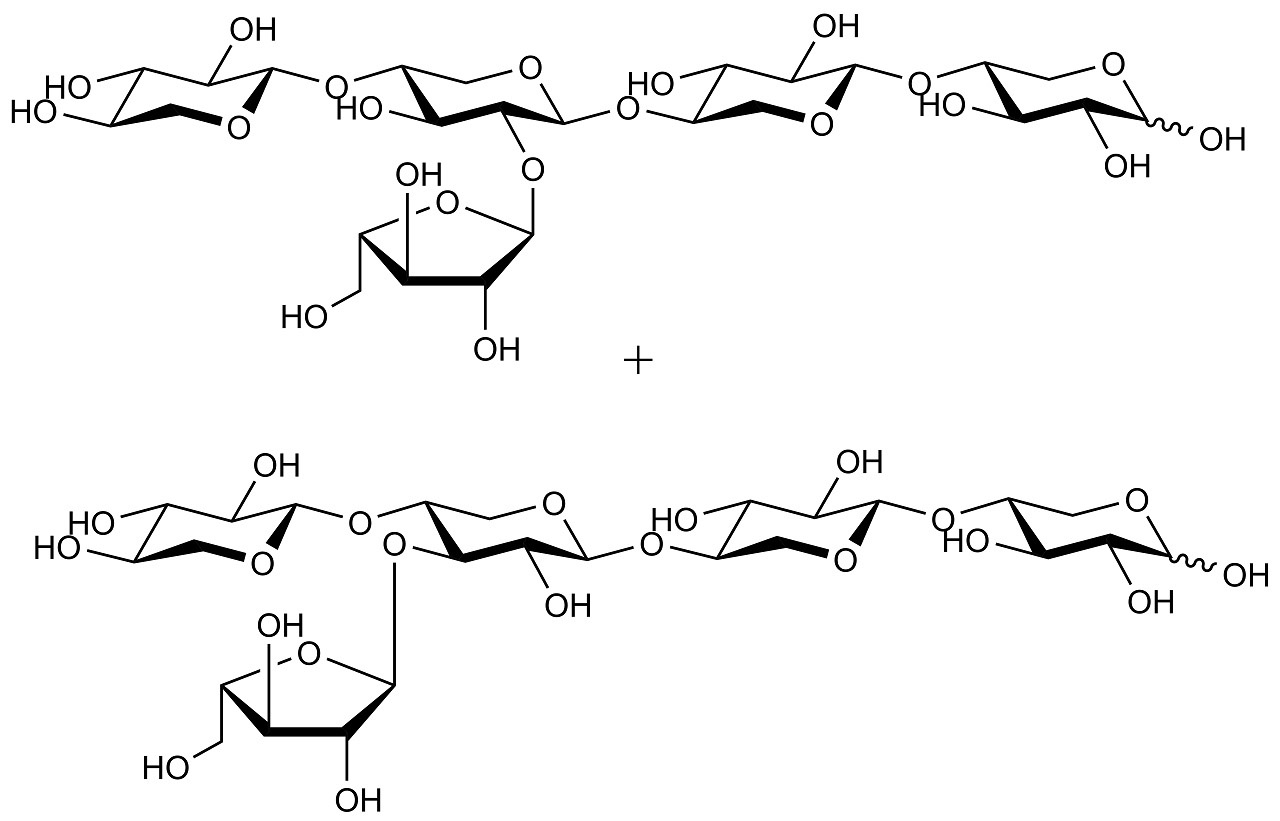
33-α-L- plus 23-α-L-Arabinofuranosyl-xylotetraose (XA3XX/XA2XX) mixture
O-XAXXMIX-10MG10 mg
33-α-L- plus 23-α-L-Arabinofuranosyl-xylotetraose (XA3XX/XA2XX) mixture
O-XAXXMIX-30MG30 mg
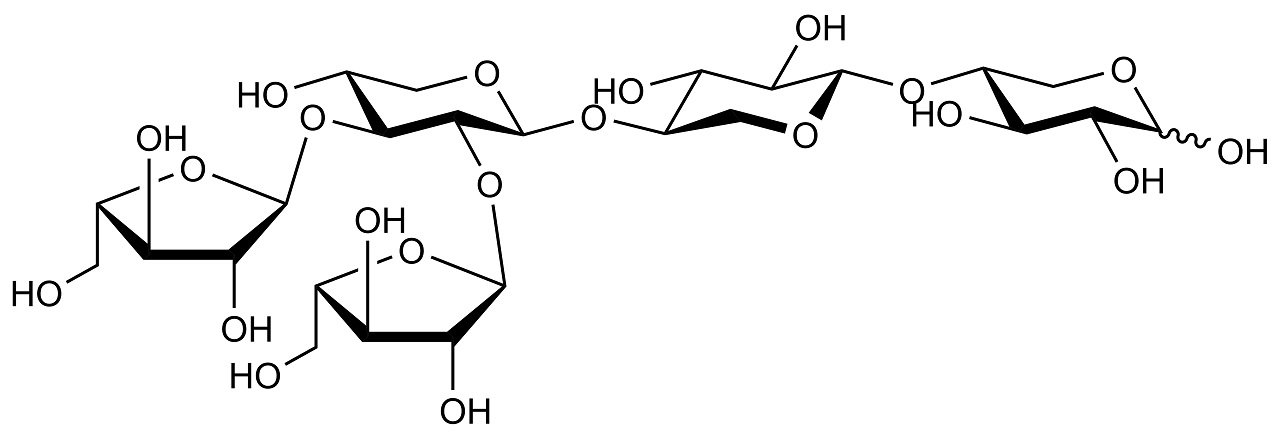
23,33-di-α-L-Arabinofuranosyl-xylotriose (A2,3XX)
O-A23XX-30MG30 mg
23,33-di-α-L-Arabinofuranosyl-xylotriose (A2+3XX)
O-A23XX-50MG50 mg
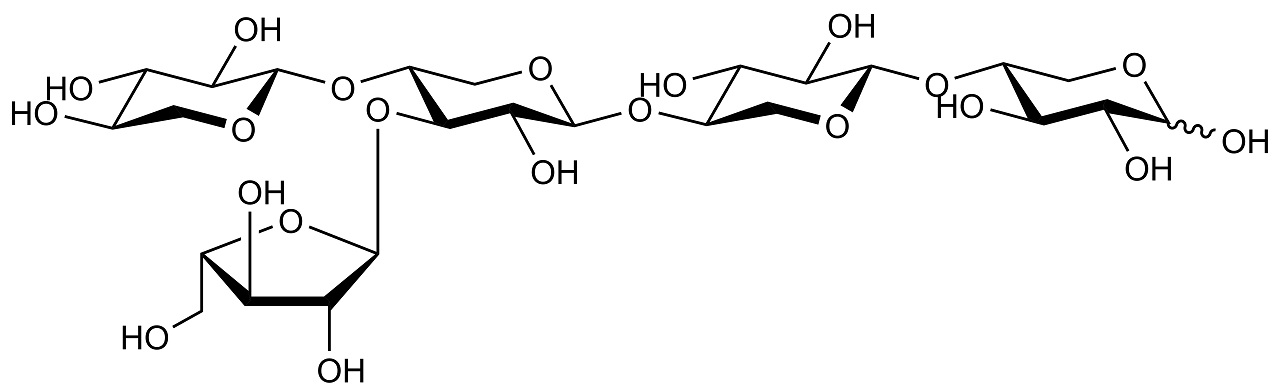
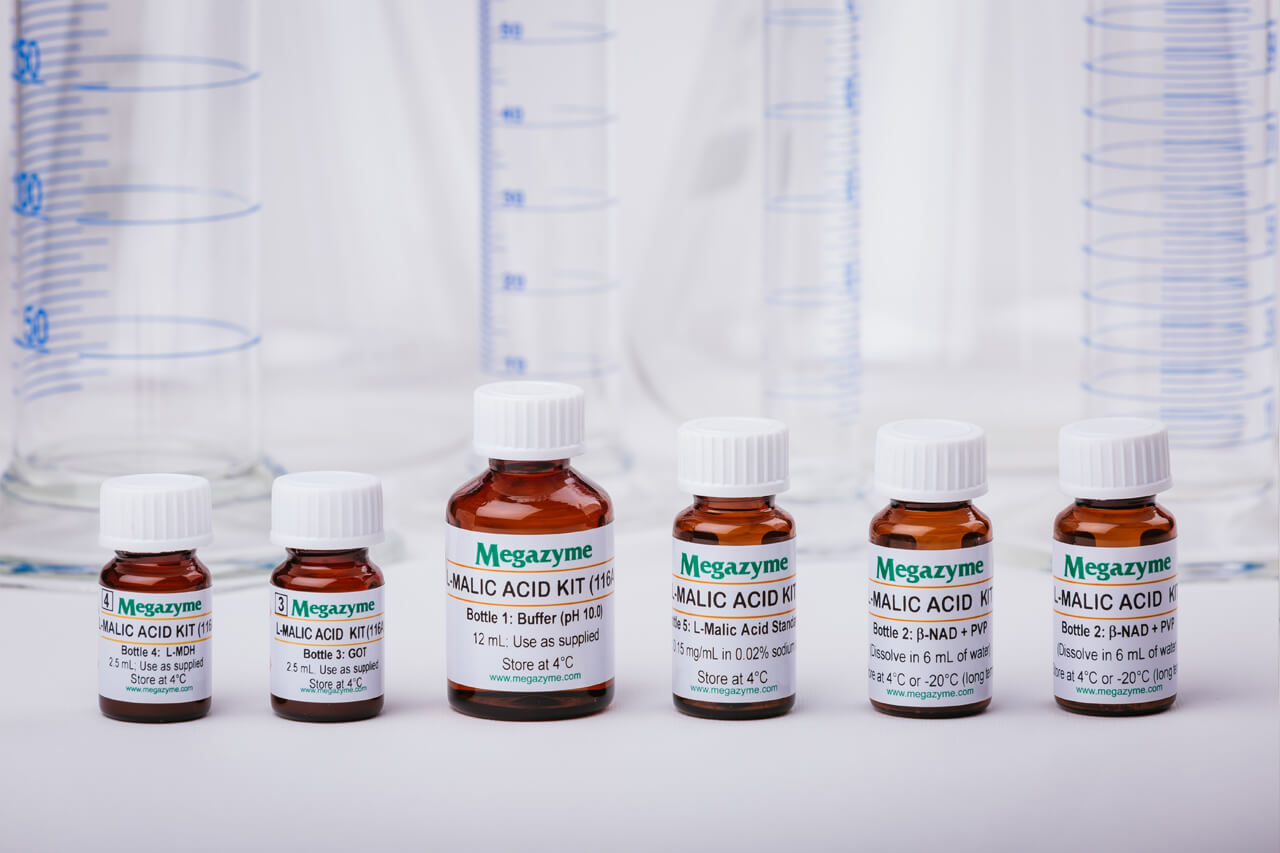
58 assays (manual) / 580 assays (microplate)
L-Malic Acid Assay Kit (Manual Format)
700004311 / K-LMAL-116A116 assays (manual) / 1160 assays (microplate)
L-Malic Acid Assay Kit (Manual Format)
Discontinued / K-LMAL-58A58 assays (manual) / 580 assays (microplate)
β-Glucazyme Tablets
Discontinued / T-BGZ-200T200 Tablets
β-Glucazyme Tablets
700005097 / T-BGZ-1000T1,000 Tablets


