
Megazyme and Dietary Fiber
In this section:
- Setting new standards
- CODEX methods offered by Megazyme
- Measurement of individual Dietary Fiber Components
- Contribution to Analytical Methodology for Total Dietary Fiber
Setting New Standards
Since 1988, Megazyme has been at the forefront of innovation in the field of cereal chemistry. Megazyme’s groundbreaking research, led by Professor Barry McCleary, has allowed the company to develop novel methods for the measurement of dietary fiber and dietary fiber components. This culminated with the publication of the McCleary Methods (AOAC 2009.01/2011.25) for Integrated Total Dietary Fiber and their successor, the RINTDF Method (AOAC 2017.16/2022.01).
RINTDF is the globally recognised reference method for the measurement of dietary fiber as it is defined by CODEX Alimentarius, and is the only method available that accurately measures all components of dietary fiber.
- Find out more about the current analytical methods used for measurement of dietary fiber
- Find out more about the RINTDF method (available from Megazyme as K-RINTDF)
- View Megazyme’s scientific publications
Codex Methods Offered by Megazyme
CODEX - the UN food safety authority which set the definition of dietary fiber in 2009 - has approved 16 methods for the measurement of dietary fiber and dietary fiber components. Six of these methods were developed by Megazyme as highlighted below.
A. Total Dietary Fiber methods
| AOAC Method | What is Measured | Megazyme Product Code |
| 2022.01 | HMWDF and SDFS IDF, SDFP and SDFS | K-RINTDF |
| 2017.16 | HMWDF and SDFS IDF, SDFP and SDFS | K-RINTDF |
| 2009.01 | HMWDF and SDFS in all foods | K-INTDF |
| 2011.25 | IDF, SDFP and SDFS in all foods | K-INTDF |
| 985.29 | HMWDF | K-TDFR |
| 991.43 | IDF and SDFP separately | K-TDFR |
B. Individual Dietary Fiber component methods
| AOAC Method | What is Measured | Megazyme Product Code |
| 995.16 | (1-3)(1-4)-β-Glucan in cereals, feeds and foods | K-BGLU |
| 997.08 | Fructans and Fructooligosaccharides (FOS) | K-FRUC |
| 999.03 | Fructans and Fructooligosaccharides (FOS) | K-FRUC |
| 2000.11 | Polydextrose | See relevant products |
| 2001.22 | Trans Galactooligosaccharides (GOS) | |
| 2002.02 | Resistant Starch (RS2 and RS3) | K-RSTAR |
C. Supplementary Dietary Fiber methods - less commonly used
| AOAC Method | What is Measured | Megazyme Product Code |
| 991.42 | IDF in Foods | K-TDFR |
| 993.19 | SDFP in Foods | K-TDFR |
| 993.21 | Total HMWDF in samples with > 10% fiber and < 2% starch | |
| 994.13 | HMWDF; provides sugar composition and Klason lignin | |
| 2001.03 | HMWDF and SDFS in foods devoid of resistant starch | |
Measurement of Individual Dietary Fiber Components
Megazyme offers assay kits and enzymes for the measurement of the major dietary fiber components, e.g. resistant starch, polydextrose and others. See the breakdown of ‘Ingredient Components’ on our What is Dietary Fiber? page to find the solution you need.
Contribution to Analytical Methodology for Total Dietary Fiber
As of 2019, Megazyme offers three different assay kits that measure Total Dietary Fiber according to AOAC methods. Two of these methods were developed entirely in-house.
- Gen. I: K-TDFR can be used for the measurement of total dietary fiber according to AOAC methods 985.29, 991.42, 991.43 and 993.19.
- Gen. II: K-INTDF can be used for the measurement of total dietary fiber according to AOAC methods 2009.01 and 2011.25, offering a TDF result in line with the 2009 Codex Alimentarius definition of dietary fiber.
- Gen. III: K-RINTDF was launched in 2015 as a further advance on the 2009.01/2011.25 method, and received AOAC approval in 2018 as the most accurate method for the measurement of TDF according to the Codex definition.
An inherent problem exists with the measurement of dietary fiber by the Prosky/Lee methods (AOAC 985.29/991.43). These methods measure some components of dietary fiber in an incomplete fashion. The diagram below attempts to highlight the issue.
A. Incomplete counting and ‘double-counting’ of components
If Prosky/Lee Methods are used to measure dietary fiber, Galacto-oligosaccharides (GOS), Raffinose and Stachyose are not measured at all while Polydextrose, Resistant Maltodextrins, Inulin, FOS, Pectin, Arabinogalactan and Resistant Starch are partially measured.
This poses a challenge for food science analysts because if, for example, Resistant Starch is measured using AOAC 2002.02 and the value obtained is added to the value for Total Dietary Fiber measured using AOAC 985.29, this results in a quantity of resistant starch being ‘double counted’ leading to an artificially high value for dietary fiber.
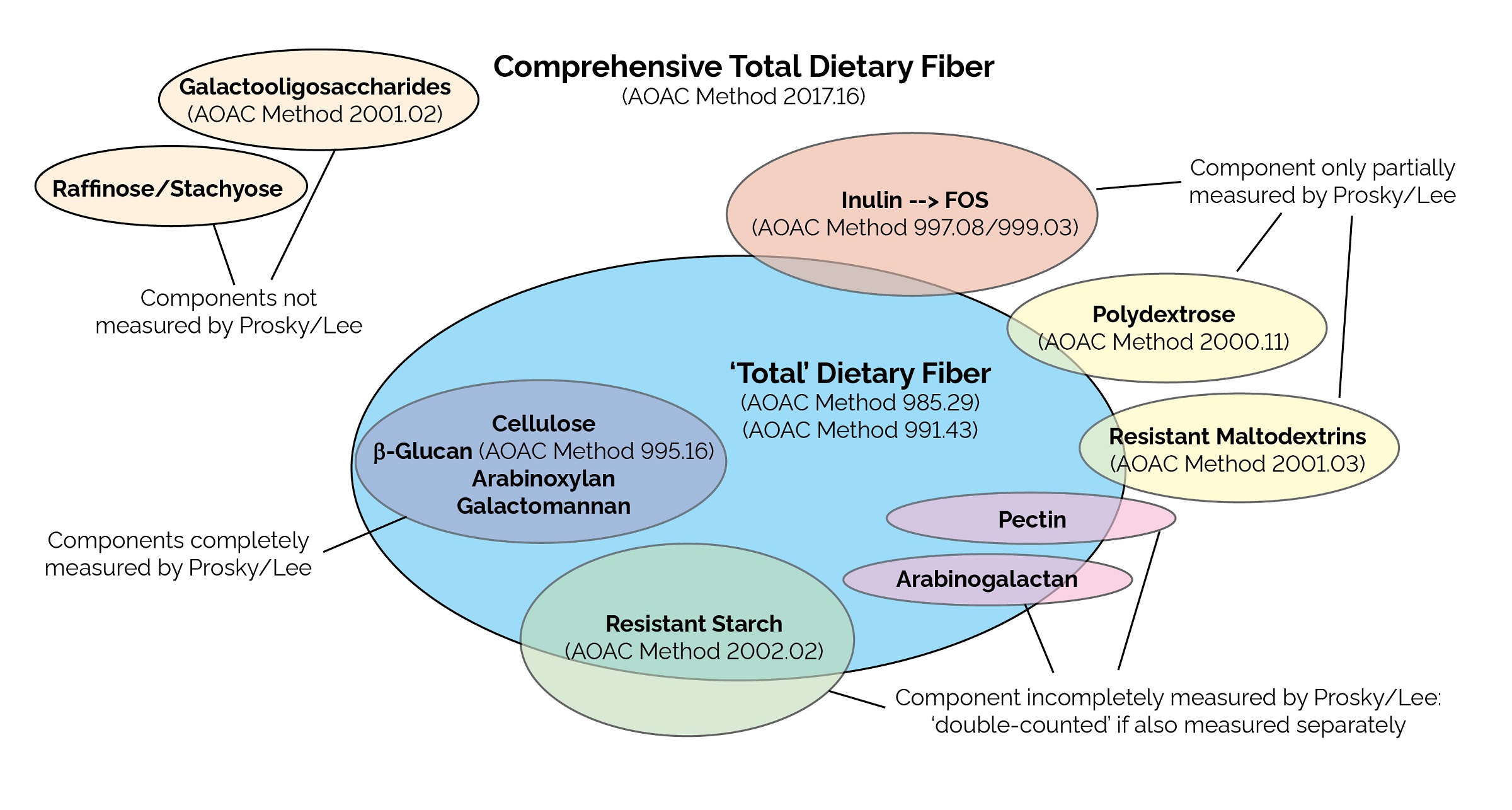
The solution to this problem is to replace the Prosky/Lee methods (AOAC 985.29/AOAC 991.43) with methods that correctly measure all components of dietary fiber (AOAC 2017.16/2022.01).
B. Method Comparison: Prosky (985.29) versus McCleary (2009.01/2011.25/2017.16/2022.01) in detail
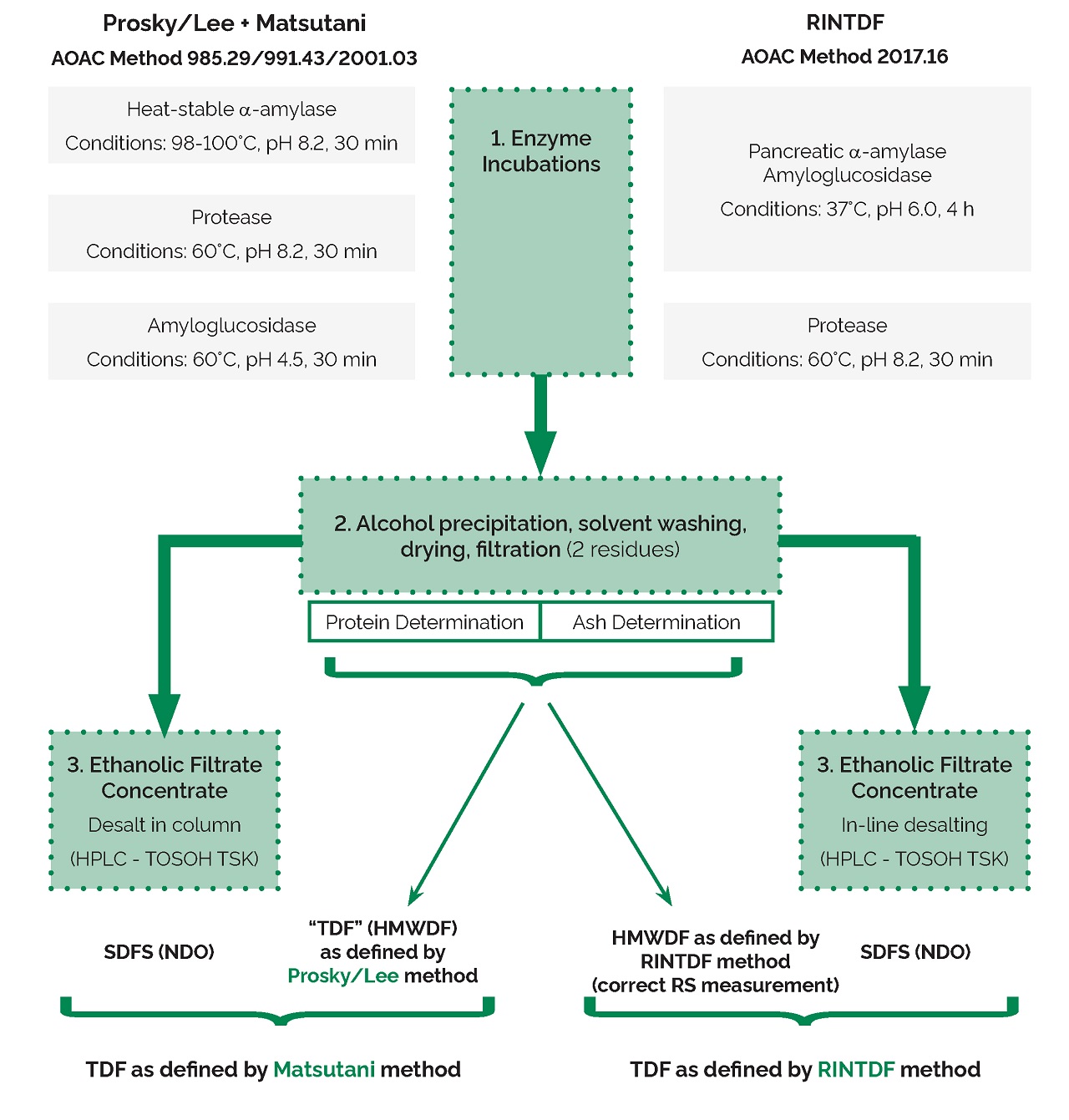
The Prosky and McCleary methods follow a similar procedure, but with some key differences that have major implications for the accuracy of the final Total Dietary Fiber result.
- Both methods involve the use of a 1 g sample.
- The enzymatic treatment step is significantly different. During the Prosky amylase incubation, the starch content in a sample is gelatinised. This is avoided under the McCleary amylase incubation, which uses physiological conditions that do not result in gelatinisation. This difference is crucial as gelatinisation removes the ‘resistant’ quality of resistant starch – an important component in dietary fiber. This leads to underestimation of total dietary fiber in certain samples using the Prosky method.
- In both methods, following an enzymatic digestion step, the non-digested material is precipitated and the protein and ash contents are determined separately and subtracted to calculate HMWDF.
The other major difference between the Prosky and McCleary methods is the inclusion of the quantification of non-digestible oligosaccharides (NDOs) by HPLC, as required in some jurisdictions. Non-digestible oligosaccharides are not measured in the Prosky method and this leads to underestimation of total dietary fiber in certain samples.
C. Which McCleary Method? Advantages of the RINTDF method (AOAC 2017.16 and AOAC 2022.01) over the Integrated TDF method (AOAC 2009.01)
As the Integrated TDF method was adopted within the industry, Megazyme’s ongoing research identified scope for further improvement of the procedure, with benefits in terms of accuracy, convenience and safety. The following adaptations were made to create the RINTDF methods, which addresses all of the reported limitations of the Integrated TDF method. RINTDF underwent interlaboratory evaluation in 2016 and was accepted as the AOAC Method 2022.01 in 2022 and AOAC Method 2017.16 in 2018.
- Shorter incubation time: In the Integrated TDF method, the incubation time with pancreatic α-amylase (PAA) plus amyloglucosidase (AMG) is 16 h, in line with published methods for measurement of RS. However a more likely time of residence of food in the small intestine is ~ 4 h, which is used in RINTDF. To obtain the same degree of hydrolysis for a range of control starches/resistant starches as obtained with AOAC Method 2009.01 in 16 h, the levels of both PAA and AMG needed to be increased substantially for the RINTDF method (PAA from 2 to 5 KU/assay and AMG from 0.14 to 1.7 KU/assay).
- Avoidance of RMD artefact: The production of small amounts of resistant maltodextrins has been reported on hydrolysis of certain starches with the Integrated TDF method. These oligosaccharides are resistant to further hydrolysis in the analytical method, but are readily hydrolysed by the mucosal α-glucosidase complex of the small intestine – thus they are an artefact generated by the analytical method and should not be included in DF. Under the revised incubation conditions employed in RINTDF, the problematic resistant maltodextrins are not formed on hydrolysis of starch.
- Improved accuracy for RS4: Results from the Integrated TDF method show some suggested underestimation of Resistance Starch 4 (phosphate cross-linked starch). While the results obtained with RINTDF are very similar to those obtained using the Integrated TDF method, higher (more physiologically relevant) values were obtained for certain phosphate cross-linked starch samples such as Fibersym® and for native high amylose maize starch (e.g. Hylon VII®).
Improved accuracy for FOS: With the Integrated TDF method, FOS was also underestimated when using the HPLC system chosen (Waters Sugar-Pak® column) as fructotriose coelutes with disaccharides and thus is not measured. To achieve complete separation of fructotriose (in FOS) from disaccharides, HPLC was performed on a TSKgel G2500PWxL® gel permeation column from Tosoh Biosciences LLC (as recommended by Matsutani Chemical Company) instead of on a Waters Corporation Sugar-Pak® column. Glycerol was used as the internal standard in place of sorbitol, because on the TSKgel G2500PWxL® column, sorbitol coelutes with glucose. This resulted in a requirement to exclude glycerol from enzyme preparations, which has been accomplished for the Rapid Integrated Total Dietary Fiber assay kit (K-RINTDF).
Safer formulation: K-INTDF uses of sodium azide in the incubation buffer to prevent microbial contamination over the 16 h incubation period. This is undesirable given that sodium azide is notably toxic. With the shorter incubation time used in RINTDF, microbial infection of the incubation solutions is not a concern, which means that sodium azide can be excluded from the incubation buffer.
As the most up-to-date and advanced method available, Megazyme recommends the RINTDF method for measurement of dietary fiber according the 2009 Codex Alimentarius definition of Dietary Fiber.
References
- Prosky, L., Asp, N-G., Furda, I., DeVries, J. W., Schweizer, T. F. & Harland, B. F. (1985). Determination of total dietary fiber in foods and food products: Collaborative study. J. AOAC Chem., 68(4), 677-679. Link to article
- McCleary, B. V., DeVries, J. W., Rader, J. I., Cohen, G., Prosky, L., Mugford, D. C. & Okuma, K. (2010). Determination of total dietary fiber (CODEX definition) by enzymatic-gravimetric method and liquid chromatography: Collaborative study. J. AOAC Int., (93)1, 221-233. Link to article
- McCleary, B. V., Sloane, N., Draga, A. & Lazewska, I. (2013). Measurement of Total Dietary Fiber Using AOAC Method 2009.01 (AACC International Approved Method 32-45.01): Evaluation and Updates. Cereal Chem., 90, 396-414. Link to article
- McCleary, B. V. (2007). An integrated procedure for the measurement of total dietary fibre (including resistant starch), non-digestible oligosaccharides and available carbohydrates. Anal. Bioanal. Chem., 389(1), 291-308. Link to article
- McCleary, B. V., Sloane, N. & Draga, A. (2015). Determination of total dietary fibre and available carbohydrates: A rapid integrated procedure that simulates in vivo digestion. Starch‐Stärke, 67(9-10), 860–883. Link to article


