
Dietary Fiber in Human Health
In this section:
- Impact of a High-Fiber Diet
- What makes Dietary Fiber so beneficial?
- References
Impact of a High Fiber Diet
Since the 1990s, there has been an explosion of interest in the area of dietary fiber from the public as well as the scientific community - to such an extent that dietary fiber is now classed as the sixth major nutrient (joining proteins, fats, sugars, vitamins and minerals). Consuming a diet rich in dietary fiber has been demonstrated to impact the following areas of human health and wellbeing:
Click image to launch pdf
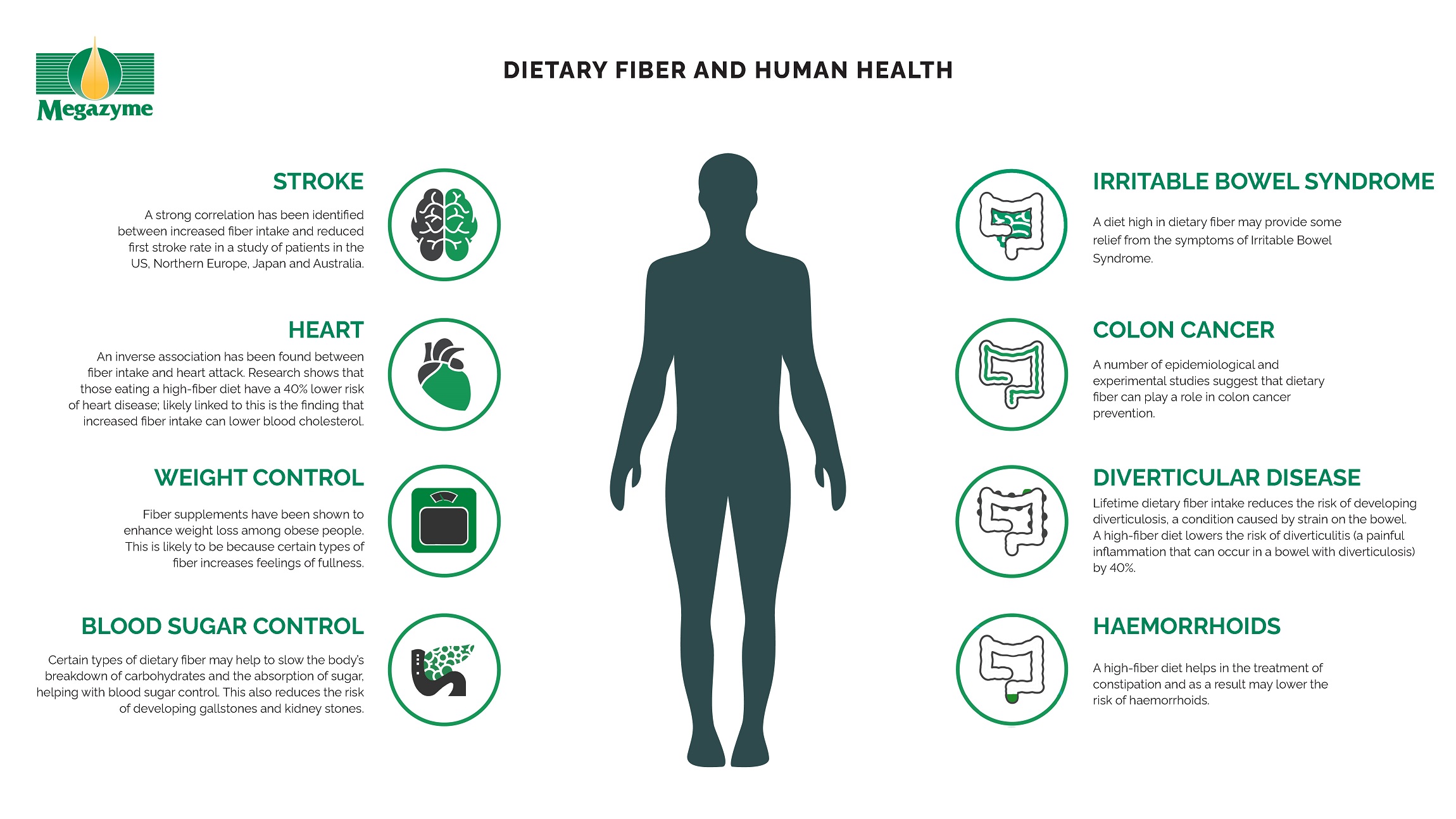
- Blood sugar: Certain types of dietary fiber may help to slow the body’s breakdown of carbohydrates and the absorption of sugar, helping with blood sugar control. This aspect could be particularly important for those people suffering from diabetes.1
- Weight control: Fiber supplements have been shown to enhance weight loss among obese people.2 This is likely to be because certain types of fiber increases feelings of fullness.
- Heart health: An inverse association has been found between fiber intake and heart attack, and research shows that those eating a high-fiber diet have a 40% lower risk of heart disease.3 Likely linked to this is the finding that increased fiber intake can lower blood cholesterol.4
- Stroke: A strong correlation between increased fiber intake and reduced first stroke rate has been identified in a recent study of patients in the US, Northern Europe, Japan and Australia.5
- Colon cancer: There are a number of epidemiological and experimental studies that suggest dietary fiber can play a role in colon cancer prevention.6
- Diverticulosis: Dietary fiber (especially insoluble) may reduce your risk of diverticulitis – an inflammation of polyps in your intestine – by 40%.7
- Haemorrhoids: A high-fiber diet certainly helps in the treatment of constipation and as a result may lower the risk of haemorrhoids.8
- Irritable bowel syndrome (IBS): Fiber may provide some relief from IBS.9
- Gallstones and kidney stones: A high-fiber diet may reduce the risk of gallstones and kidney stones, likely because of its ability to help regulate blood sugar.10
What makes dietary fiber so beneficial?
There are two main characteristics of fiber that result in almost all of its well documented health benefits and both arise from the simple fact that dietary fiber passes through the small intestine intact and travels to the large intestine where it can be either partially or fully fermented depending on the type of dietary fiber in question.
A. Reduced Bowel Transit Times
Traditionally, fiber was thought to be good for you because it acted as a way to ‘clean out’ your digestive system by the simple mechanical process of passing through it. There is undoubtedly sound scientific evidence to reinforce this concept. Reduced bowel transit times ensure reduced contact between carcinogenic compounds and mucosal cells and dietary fiber could bind or excrete potential luminal carcinogens like secondary bile acids.11-12
B. Impact on Gut Microbiome
More recently, attention has shifted to the ability of fiber to improve overall gut health which has numerous downstream benefits. This occurs mainly as a result of the change in composition of the gut microbiome. The large intestine contains trillions of bacteria.13 There are ten times more bacteria in our colon than there are native cells in our bodies. Crucially, ingesting certain dietary fiber components, namely prebiotics, can increase the relative populations of ‘healthy’ bacteria such as Bacteroidetes over ‘unhealthy’ bacteria such as Firmicutes.14
These population changes can result in increased levels of short chain fatty acids (SCFAs) including butyric acid, propionic acid and acetic acid. Butyrate is the major energy source for colonocytes. Propionate is largely taken up by the liver. Acetate enters the peripheral circulation to be metabolised by peripheral tissues. It is these SCFAs that are now believed to be responsible for many of the health benefits associated with dietary fiber.15
In recent years, food manufacturers have taken advantage of the growing body of scientific knowledge in this area to develop prebiotic and probiotic fibers as foods and food ingredients that can produce beneficial health effects. Regulatory bodies closely monitor health claims and rule on exactly what can and can’t be claimed on a packages label. For more information on the regulatory aspects of dietary fiber please see the section on dietary fiber regulations.
References
- Jenkins, A. L., Jenkins, D. J. A., Wolever, T. M. S., Rogovik, A. L., Jovanovski, E., Božikov, V., Rahelić, D. & Vuksan, V. (2008). Comparable Postprandial Glucose Reductions with Viscous Fiber Blend Enriched Biscuits in Healthy Subjects and Patients with Diabetes Mellitus: Acute Randomized Controlled Clinical Trial. Croat. Med. J., 49(6), 772-782. Link to article
- Anderson, J. W., Baird, P., Davis, R. H. Jr., Ferreri, S., Knudtson, M., Koraym, A., Waters, V. & Williams, C. L. (2009). Health benefits of dietary fiber. Nutr. Rev., 67(4), 188-205. Link to article
- Rimm, E. B., Ascherio, A., Giovannucci, E., Spiegelman, D., Stampfer, M. J. & Willett W. C. (1996). Vegetable, fruit, and cereal fiber intake and risk of coronary heart disease among men. Jama., 275(6), 447-51. Link to article
- Brown, L., Rosner, B., Willett, W. W. & Sacks, F. M. (1999). Cholesterol-lowering effects of dietary fiber: a meta-analysis. Am. J. Clin. Nutr. , 69(1), 30-42. Link to article
- Threapleton, D. E., Greenwood, D. C., Evans, C. E., Cleghorn, C. L., Nykjaer, C., Woodhead, C., Cade, J. E., Gale, C. P. & Burley, V. J. (2013). Dietary fiber intake and risk of first stroke: a systematic review and meta-analysis. Stroke, 44(5), 1360-1368. Link to article
- Zeng, H., Lazarova, D. L. & Bordonaro, M. (2014). Mechanisms linking dietary fiber, gut microbiota and colon cancer prevention. World J. Gastrointest. Oncol., 6(2), 41-51. Link to article
- Aldoori, W. H., Giovannucci, E. L., Rockett, H. R., Sampson, L., Rimm, E. B. & Willett, W. C. (1998). A prospective study of dietary fiber types and symptomatic diverticular disease in men. J. Nutr., 128(4), 714-719. Link to article
- Alonso-Coello, P., Mills, E., Heels-Ansdell, D., López-Yarto, M., Zhou, Q., Johanson, J. F. & Guyatt, G. (2006). Fiber for the treatment of hemorrhoids complications: a systematic review and meta-analysis. Am. J. Gastroenterol., 101(1), 181-188. Link to article
- Zuckerman, M. J. (2006). The role of fiber in the treatment of irritable bowel syndrome: therapeutic recommendations. J. Clin. Gastroenterol., 40(2), 104-108. Link to article
- Scragg, R. K., McMichael, A. J. & Baghurst, P. A. (1984). Diet, alcohol, and relative weight in gall stone disease: a case-control study. Br. Med. J. (Clin. Res. Ed.), 288(6424), 1113-1119. Link to article
- Lattimer, J. M. & Haub, M. D. (2010). Effects of Dietary Fiber and Its Components on Metabolic Health. Nutrients, 2(12), 1266-1289. Link to article
- Macfarlane, G. T. & Macfarlane, S. (2012). Bacteria, colonic fermentation, and gastrointestinal health. J. AOAC Int., 95(1), 50-60. Link to article
- Backhed, F., Ley, R. E., Sonnenburg, J. L., Peterson, D. A. & Gordon, J. I. (2005). Host-bacterial mutualism in the human intestine. Science, (307)5717, 1915-1920. Link to article
- Parnell, J. A. & Reimer, R. A. (2012). Prebiotic fibres dose-dependently increase satiety hormones and alter Bacteroidetes and Firmicutes in lean and obese JCR:LA-cp rats. Br. J. Nutr., 107(4), 601-613. Link to article
- Wong, J. M., de Souza, R., Kendall, C. W., Emam, A. & Jenkins, D. J. (2006). Colonic health: fermentation and short chain fatty acids. J. Clin. Gastroenterol., 40(3), 235-43. Link to article


