
Measurement of Dietary Fiber: Current Methodology
In this section:
- Basic Principles of Dietary Fiber Analysis
- Current Analytical Methods
- Measurement of Soluble and Insoluble Dietary Fiber
- Measurement of Dietary Fiber Components
Basic Principles of Dietary Fiber Analysis
Food manufacturers invest research and resources into means of maximising the dietary fiber content of their products. It is therefore important for the industry to have reliable and accurate means of measuring dietary fiber in a product for labelling purposes.
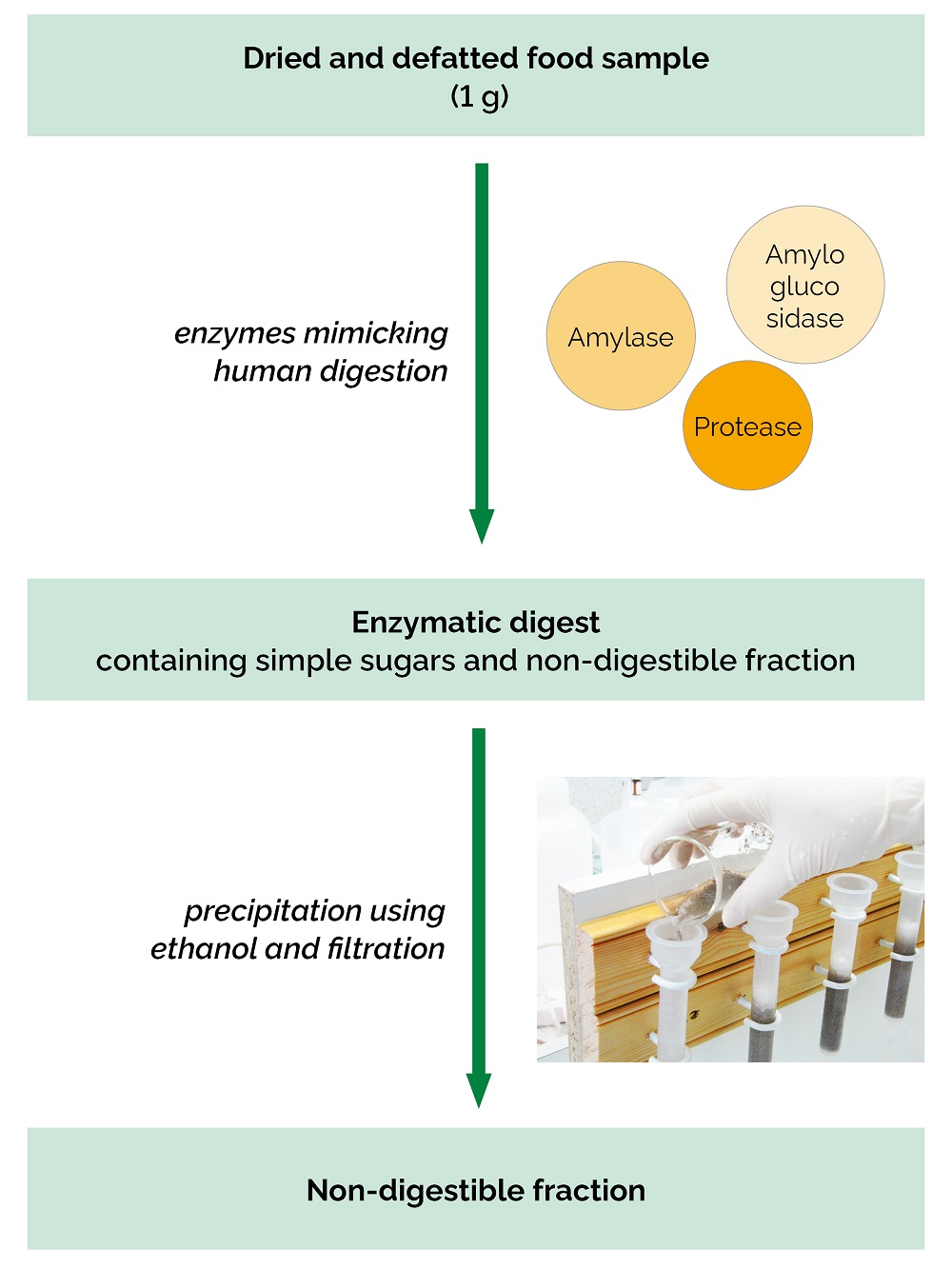
In its simplest terms, dietary fiber content in a sample is measured in the laboratory using an enzymatic-gravimetric method.
After defatting, a food sample is treated with enzymes that mimic the digestive process in the human small intestine. Digestible carbohydrates are broken down into simple sugars and removed from the sample by precipitation and filtration. This mimics absorption of these sugars in the body.
The non-digestible precipitate contains the dietary fiber but also contains protein and inorganic material.
These should not be included in the total dietary fiber, so protein and inorganic material must be measured in a separate process and subtracted from the weight.
Current Analytical Methods
There are three commonly-used methods for the measurement of Total Dietary Fiber:
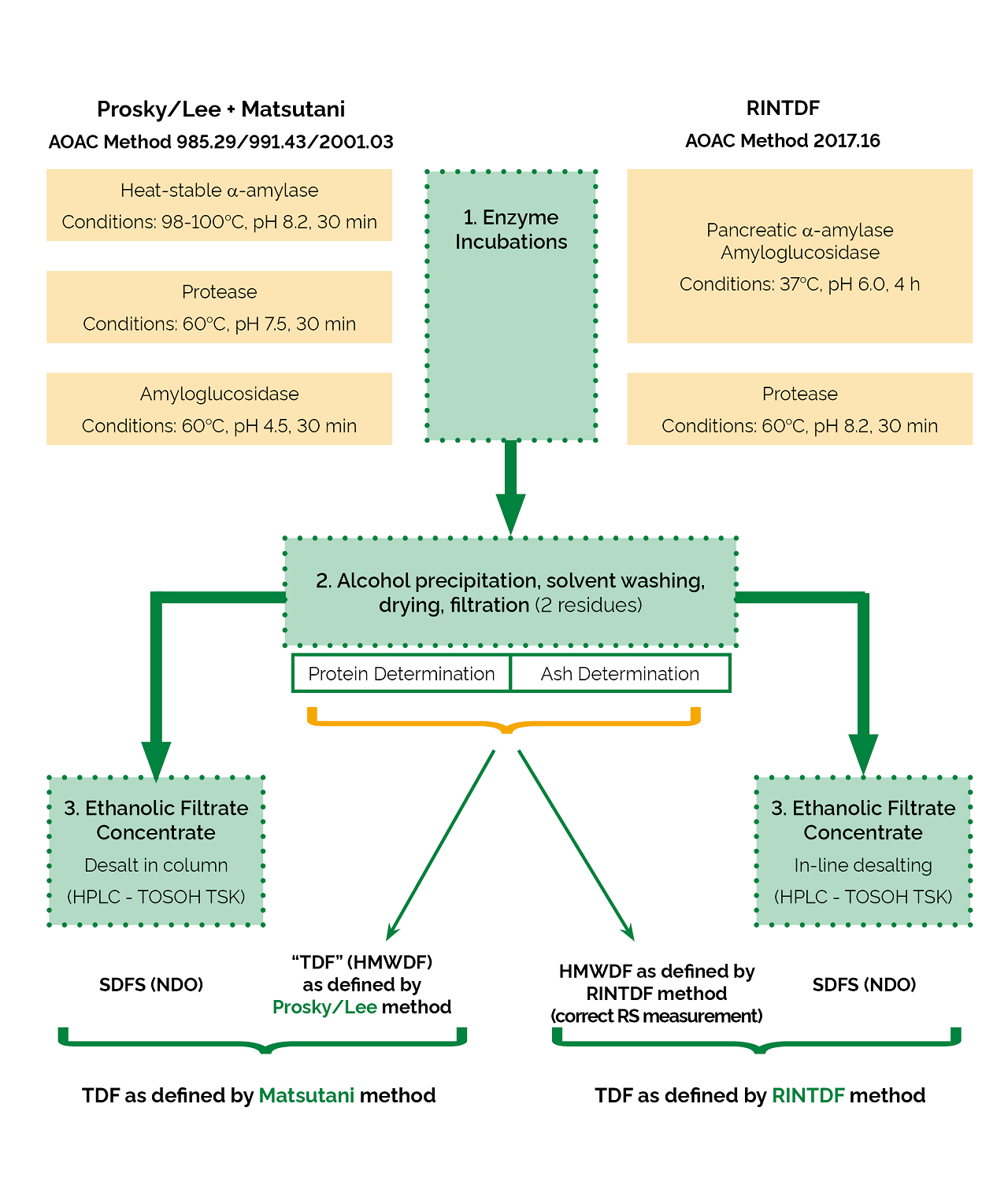
1. Prosky/Lee Methods (AOAC 985.29/991.43)1 Introduced in 1985. Uses bacterial α-amylase and harsh conditions (pH 8.2, 100oC) for the enzymatic incubation step. This method does not measure all components of dietary fiber as currently defined by CODEX Alimentarius (international regulatory body for food ingredients). Most resistant starch and all non-digestible oligosaccharides are not included which results in an underestimation of dietary fiber.
Available from Megazyme in the Total Dietary Fiber Assay Kit (K-TDFR)
2. McCleary Method (AOAC 2009.01/2011.25)2-4 Introduced in 2009. Uses pancreatic α-amylase and conditions much closer to physiological (pH 6, 37oC) for the enzymatic incubation step. This method measures all components of dietary fiber as currently defined by CODEX Alimentarius.
Available from Megazyme in the Integrated Total Dietary Fiber Assay Kit (K-INTDF)
3. Rapid Integrated Total Dietary Fiber (AOAC 2017.16/2022.01)5 Introduced in 2015. Closely resembles AOAC 2009.01. These methods address the minor limitations that have been identified in the McCleary Method (AOAC 2009.01) and are the only methods that accurately measures all components of Total Dietary Fiber (including all forms of resistant starch).
Available from Megazyme in the Rapid Integrated Total Dietary Fiber Assay Kit (K-RINTDF)
Measurement of Soluble and Insoluble Dietary Fiber
In certain cases, it is desirable to know what type of dietary fiber is present in a sample. Modifications to the standard methods (an additional filtration step) exist and these allow the dietary fiber content to be divided into soluble and insoluble dietary fiber (SDF and IDF). In both cases, all other steps in the method remain unchanged.
Measurement of Dietary Fiber Components
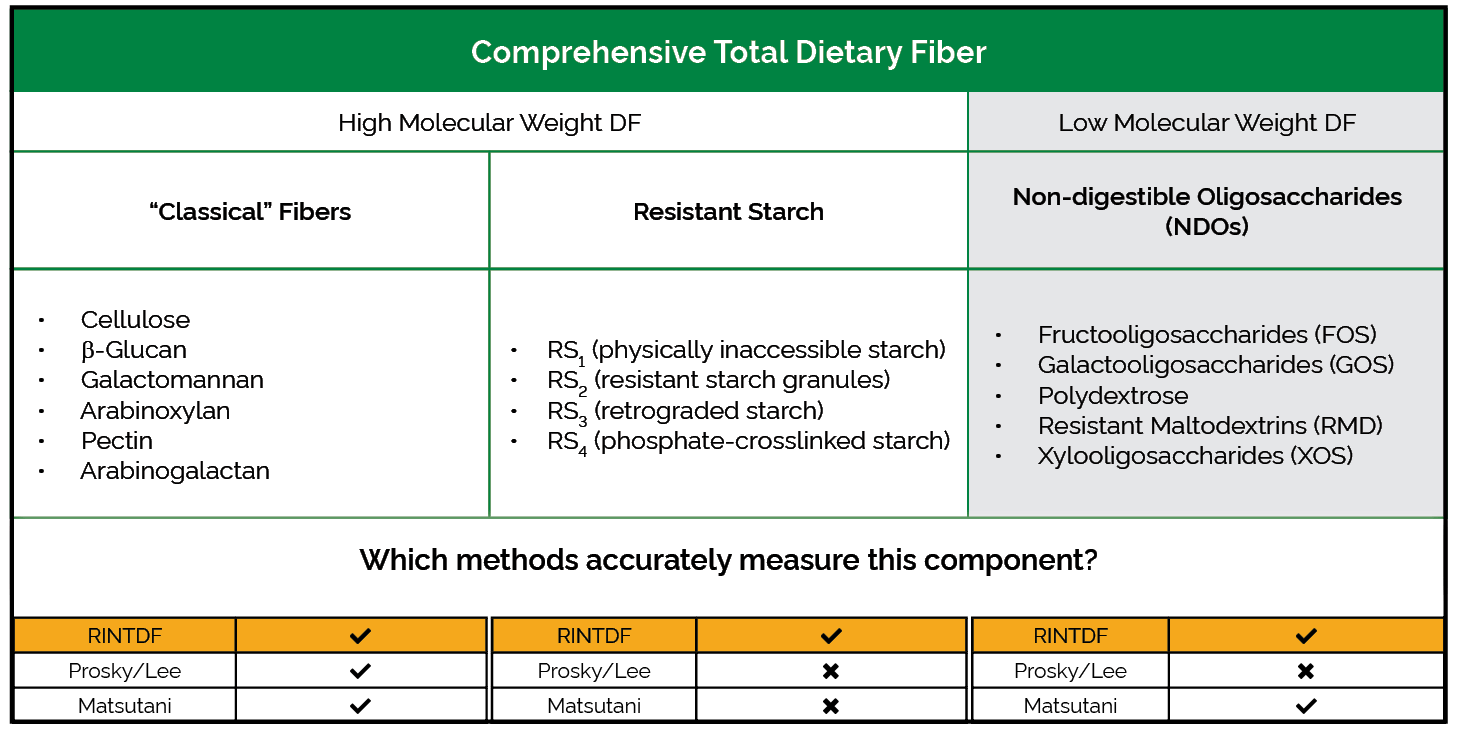
The term ‘dietary fiber’ refers to a diverse group of components which can be measured separately or together. The most suitable method to use will vary depending on which components are already known to be present within the sample.
- HMWDF includes natural fibers such as cellulose, β-glucan, galactomannan, arabinoxylan, pectin and arabinogalactan.
- Resistant Starch comes from a variety of sources (see table below for types of Resistant Starch).
- NDO includes inulin/FOS, GOS, polydextrose, resistant maltodextrin (such as Fibersol 2) and xylooligosaccharides (XOS).
Megazyme also offers assay kits and reagents for the measurement of individual dietary fiber components. See the ‘What is Dietary Fiber’ page for more information.


