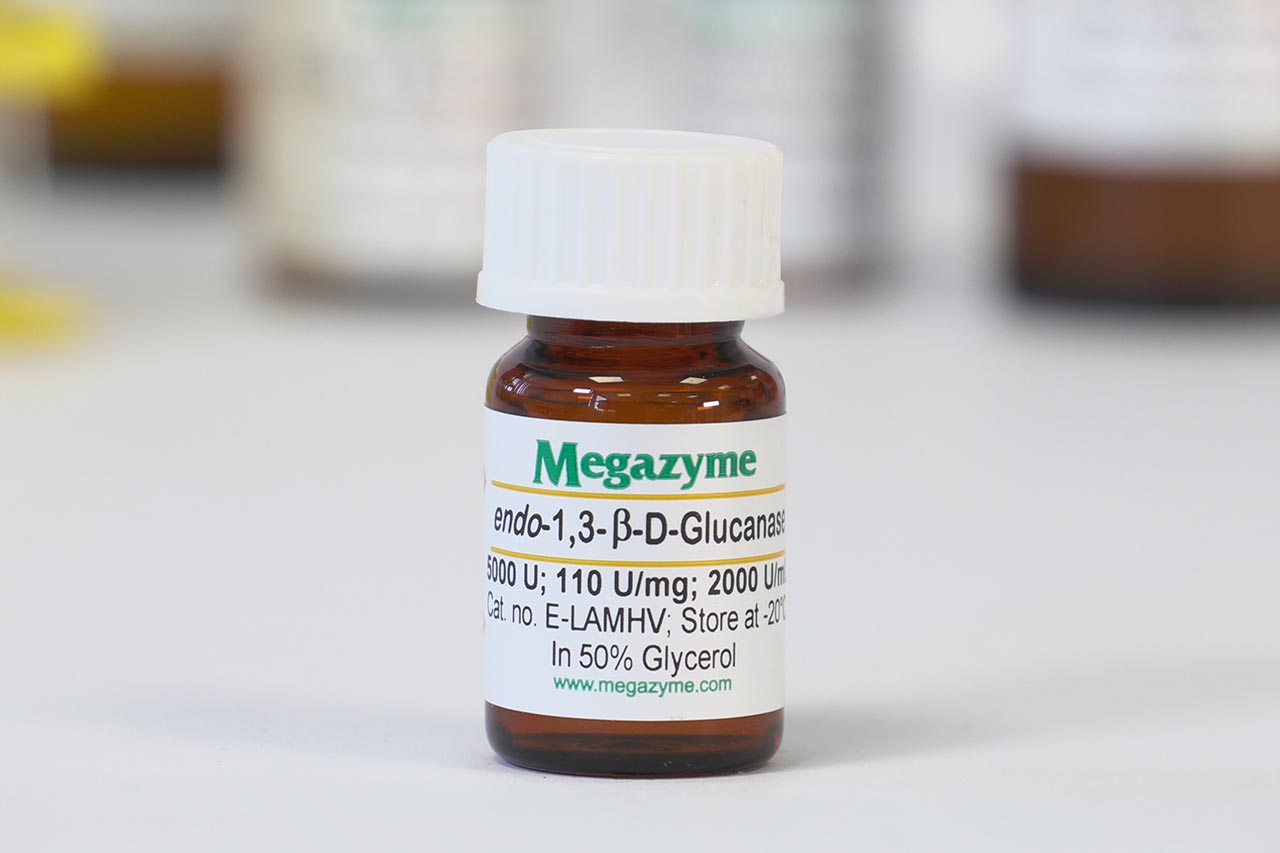
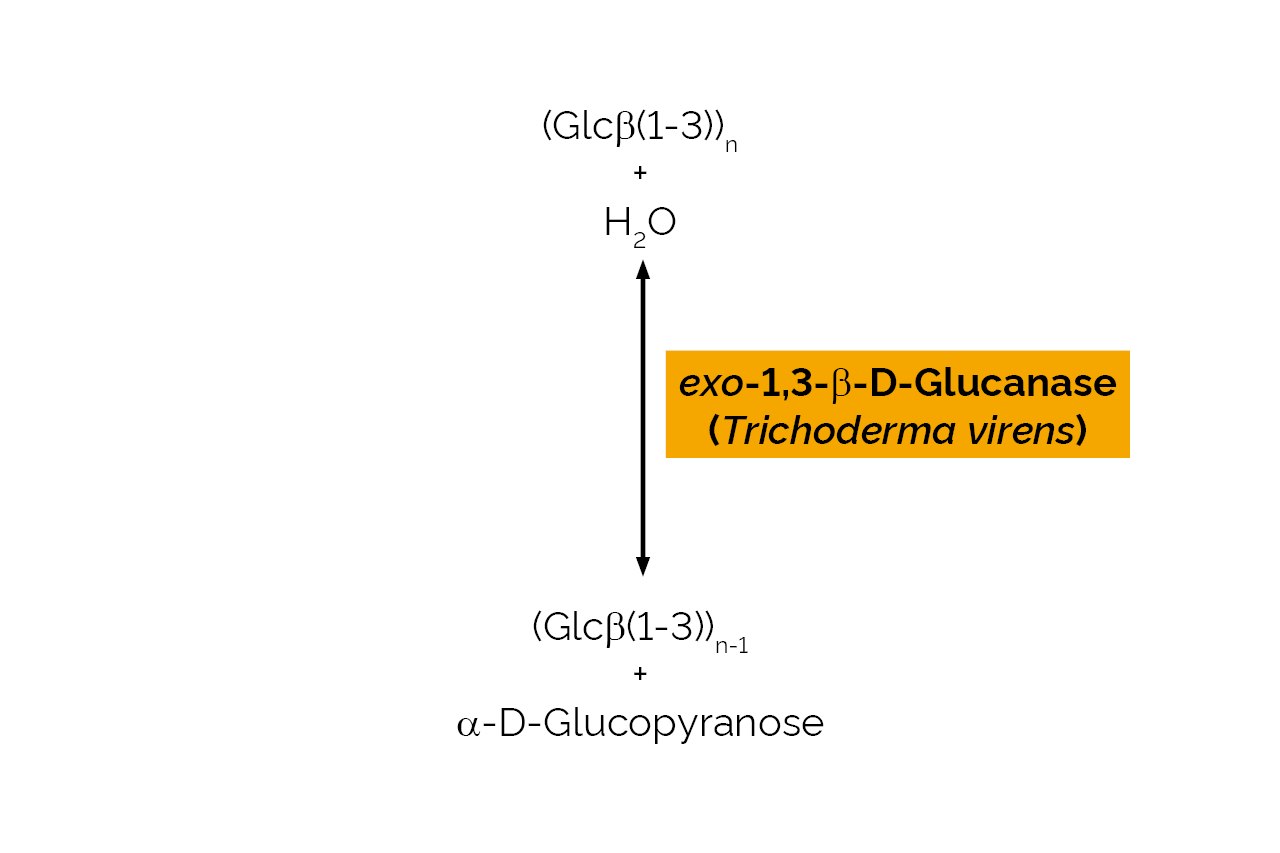
exo-1,3-β-D-Glucanase (Trichoderma virens)
400 Units at 50oC;
~ 260 Units at 40oC
This product has been discontinued
~ 260 Units at 40oC
~ 60 U/mg (40oC, pH 4.5 on laminarin)
This product has been discontinued.
High purity recombinant exo-1,3-β-D-Glucanase (Trichoderma virens) for use in research, biochemical enzyme assays and analytical testing applications.
Browse more CAZymes for diverse applications.
Related Products
Similar Products
Related Carbohydrates
Associated Enzymes
Publications

Structure-Based Engineering to Improve Thermostability of Acetivibrio thermocellus At Bgl1A β-Glucosidase.
Pitchayatanakorn, P., Putthasang, P., Chomngam, S., Jongkon, N., Choowongkomon, K., Kongsaeree, P., Shinya Fushinobu, S. & Kongsaeree, P. T. (2025). ACS Omega. 10(25), 27153-27164.
Structure-Based Engineering to Improve Thermostability of Acetivibrio thermocellus At Bgl1A β-Glucosidase.
Pitchayatanakorn, P., Putthasang, P., Chomngam, S., Jongkon, N., Choowongkomon, K., Kongsaeree, P., Shinya Fushinobu, S. & Kongsaeree, P. T. (2025). ACS Omega. 10(25), 27153-27164.
β-Glucosidases are essential enzymes in cellulose degradation and hold significant promise for industrial applications, particularly in biorefinery processes. This study focused on the structural and functional characterization of AtBgl1A, a glycoside hydrolase family 1 β-glucosidase from Acetivibrio thermocellus, and its rational engineering to enhance thermostability. AtBgl1A exhibited over 400-fold higher specificity for laminaribiose than cellobiose, supporting its physiological role in laminaribiose metabolism. The crystal structure of the wild-type AtBgl1A was determined at 2.37-Å resolution, and served as a guide for the design of thermostabilizing mutations. Among variants, the A17S/S39T/T105V triple mutant showed the most significant improvement in thermostability, with a 145 min increase in half-life at 70 and a 5.6°C elevation in inactivation temperature, while retaining comparable kinetic efficiency. This mutant also outperformed both the wild-type AtBgl1A and commercial enzyme in hydrolyzing cellulose and laminaran at both 60 and 70 °C. Molecular dynamics simulations and residue interaction analyses suggested that the enhanced thermostability was associated with additional hydrogen bonds, van der Waals contacts, and hydrophobic interactions introduced by the mutations. These findings provide valuable insights into the structural determinants of thermostability in GH1 β-glucosidases and demonstrate the potential of rational protein engineering for developing robust biocatalysts for industrial biomass conversion.
Comparative study on the structures of intra-and extra-cellular polysaccharides from Penicillium oxalicum and their inhibitory effects on galectins.
Zhang, S., Qiao, Z., Zhao, Z., Guo, J., Lu, K., Mayo, K. H. & Zhou, Y. (2021). International Journal of Biological Macromolecules, 181, 793-800.
Comparative study on the structures of intra-and extra-cellular polysaccharides from Penicillium oxalicum and their inhibitory effects on galectins.
Zhang, S., Qiao, Z., Zhao, Z., Guo, J., Lu, K., Mayo, K. H. & Zhou, Y. (2021). International Journal of Biological Macromolecules, 181, 793-800.
Here, we compare the content and composition of polysaccharides derived from the mycelium (40.4 kDa intracellular polysaccharide, IPS) and culture (27.2 kDa extracellular polysaccharide, EPS) of Penicillium oxalicum. Their chemical structures investigated by IR, NMR, enzymolysis and methylation analysis indicate that both IPS and EPS are galactomannans composed of α-1,2- mannopyranose (Manp) and α-1,6-Manp in a backbone ratio of ~3:1, respectively, both decorated with β-l,5-galactofuranose (Galf) side chains. A few β-l,6-Galf residues were also detected in the IPS fraction. EPS and IPS have different molecular weights (Mw) and degrees of branching. IPS obtained by alkaline extraction of P. oxalicum have been reported to be galactofuranans, a composition different from our IPS. Up to now, there have been no reports on the fine structure of EPS. Our results of galectin-mediated hemagglutination demonstrate that IPS exhibits greater inhibitory effects on five galectins compared with EPS. In addition, we find that Galf, a five-membered ring form of galactose, can also inhibit galectins. IPS may provide a new source of galectin inhibitors. These results increase our understanding of structure-activity relationships of polysaccharides as galectin inhibitors.
Safety Information
Download Safety Data Sheet
Select a specific region and the Safety Data Sheet will open in a new window. Please make sure your browser doesn’t block pop-up windows

Receive Megazyme’s latest articles, news, product introductions and promotions
Customers also viewed

300 Units exo-1,3-β-glucanase / 60 Units β-glucosidase