Glucuronoyl Esterase Assay Kit
100 assays per kit
This product has been discontinued
Long term stability: See individual component labels
Advantages
- Cost effective
- All reagents stable for > 2 years
- Specific for glucuronoyl esterase
- Suitable for use in crude enzyme preparations
- Suitable for manual and auto-analyser formats
- Standard included
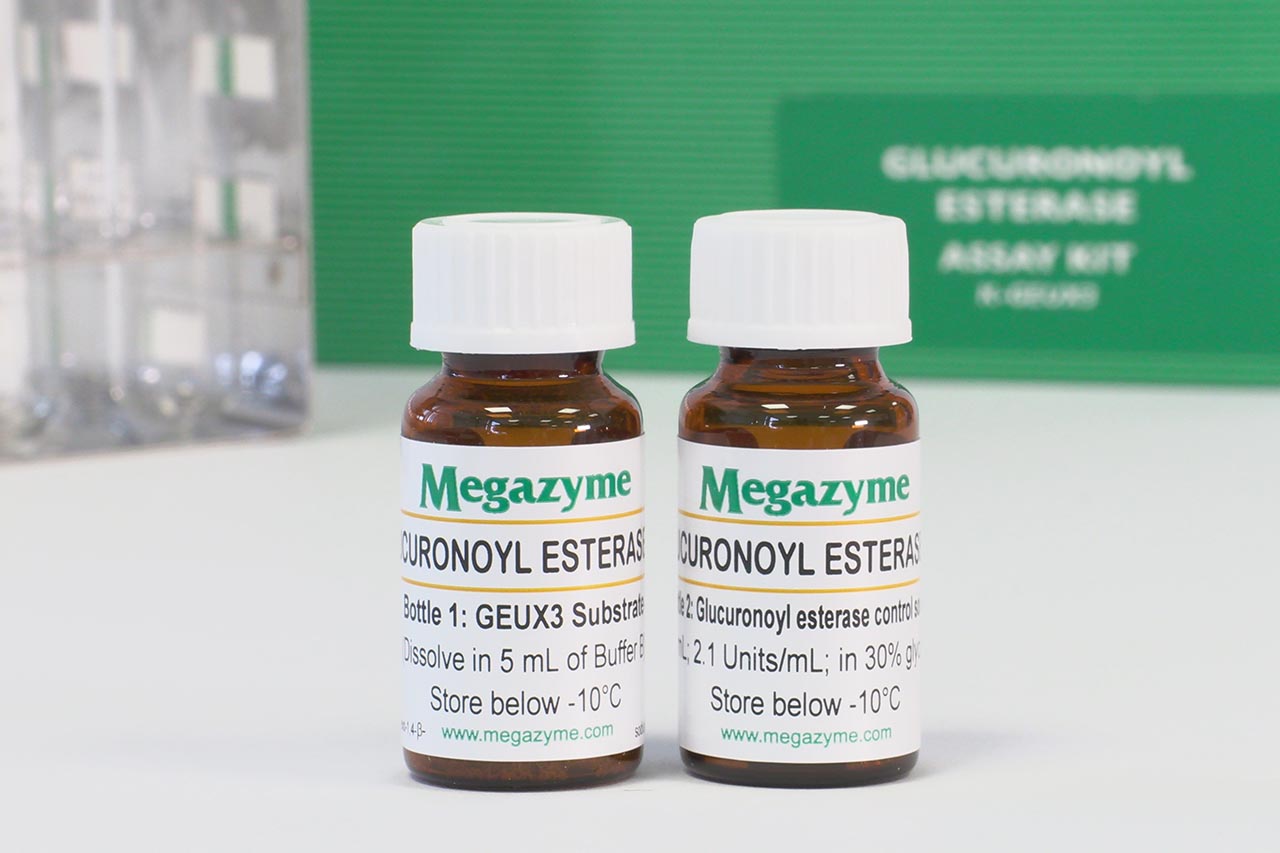
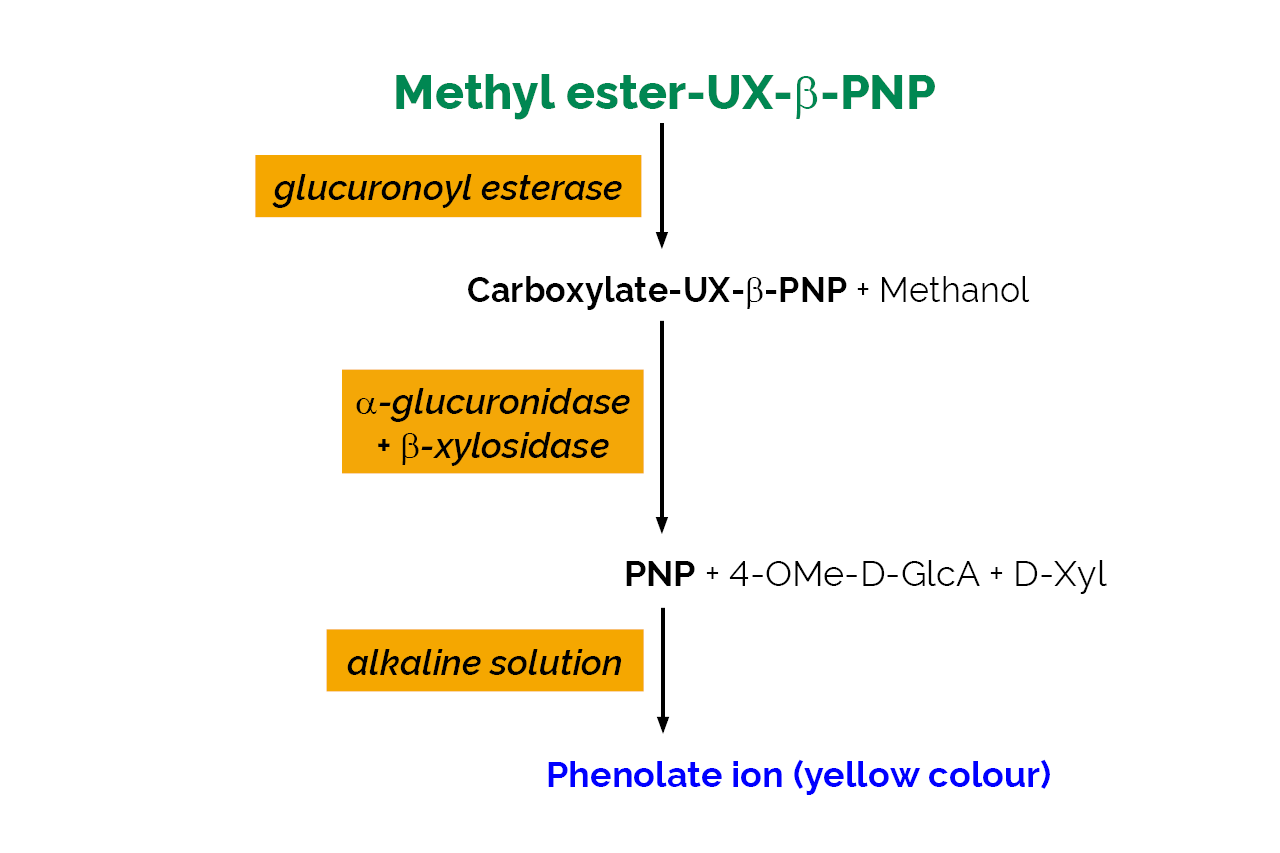
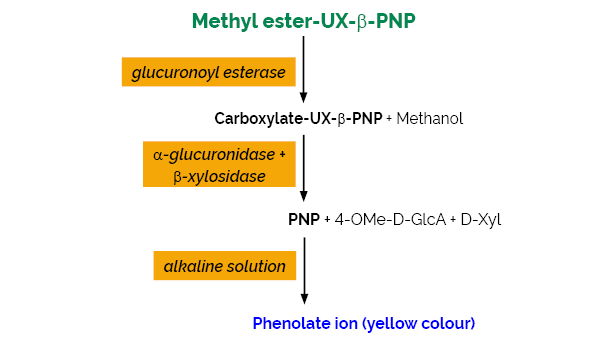
The Glucuronoyl Esterase Assay Kit provides a simple robust method for the measurement of glucuronoyl esterase. The assay kit employs a novel colourimetric reagent, termed GEUX3 that is highly specific for glucuronoyl esterase.
Browse more enzyme activity assay kits.
Publications

Structural and functional investigation of a fungal member of carbohydrate esterase family 15 with potential specificity for rare xylans.
Mazurkewich, S., Scholzen, K. C., Brusch, R. H., Poulsen, J. C., Theibich, Y., Hüttner, S., Olsson, L., Larsbrink, J. & Lo Leggio, L. (2023). Acta Crystallographica Section D: Structural Biology, 79(6), 545-555.
Structural and functional investigation of a fungal member of carbohydrate esterase family 15 with potential specificity for rare xylans.
Mazurkewich, S., Scholzen, K. C., Brusch, R. H., Poulsen, J. C., Theibich, Y., Hüttner, S., Olsson, L., Larsbrink, J. & Lo Leggio, L. (2023). Acta Crystallographica Section D: Structural Biology, 79(6), 545-555.
In plant cell walls, covalent bonds between polysaccharides and lignin increase recalcitrance to degradation. Ester bonds are known to exist between glucuronic acid moieties on glucuronoxylan and lignin, and these can be cleaved by glucuronoyl esterases (GEs) from carbohydrate esterase family 15 (CE15). GEs are found in both bacteria and fungi, and some microorganisms also encode multiple GEs, although the reason for this is still not fully clear. The fungus Lentithecium fluviatile encodes three CE15 enzymes, of which two have previously been heterologously produced, although neither was active on the tested model substrate. Here, one of these, LfCE15C, has been investigated in detail using a range of model and natural substrates and its structure has been solved using X-ray crystallography. No activity could be verified on any tested substrate, but biophysical assays indicate an ability to bind to complex carbohydrate ligands. The structure further suggests that this enzyme, which possesses an intact catalytic triad, might be able to bind and act on more extensively decorated xylan chains than has been reported for other CE15 members. It is speculated that rare glucuronoxylans decorated at the glucuronic acid moiety may be the true targets of LfCE15C and other CE15 family members with similar sequence characteristics.
Safety Information
Download Safety Data Sheet
Select a specific region and the Safety Data Sheet will open in a new window. Please make sure your browser doesn’t block pop-up windows

Receive Megazyme’s latest articles, news, product introductions and promotions
Customers also viewed

6,000 Units Oligo-α-1,6-Glucosidase plus 6,000 Units β-Galactosidase
25 assays (manual) / 250 assays (microplate) / 220 assays (auto-analyser)